

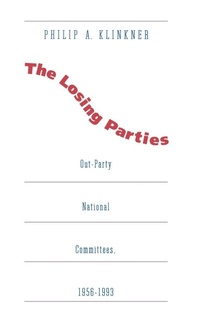
The Losing Parties
Out-Party National Committees, 1956-1993
Will be published approx. on 10. January 1995
Book
Hardback
288 pages
978-0-300-06008-9 (ISBN)
Description
How do Democratic and Republican party leaders react after their party has lost a presidential election? Is there a pattern of response to defeat that reflects the distinctive cultures of the two parties? This book answers these questions by examining how the two national party organizations have responded to presidential election defeats between 1956 and 1993.
Drawing on party documents, interviews with party officials, and contemporary accounts, Philip Klinkner provides detailed case studies of opposition party politics. He shows that Republican national committees have reacted to losses by making organizational changes to improve campaign technology and fundraising and that losing Democrats have sought to refine or make more democratic their internal procedures for selecting delegates to the national convention or for choosing presidential candidates. Klinkner suggests that the reasons for these reactions stem from the historical development of the parties. The organizational response of the Republican party is the result of its long-term relationship with business, its homogeneity and hierarchical structure, and its minority party experience. The Democrats' emphasis on participation and representation for its constituent elements is based on its characteristic composition of social and economic out-groups, its heterogeneity and decentralization, and its tradition as the majority party.
Drawing on party documents, interviews with party officials, and contemporary accounts, Philip Klinkner provides detailed case studies of opposition party politics. He shows that Republican national committees have reacted to losses by making organizational changes to improve campaign technology and fundraising and that losing Democrats have sought to refine or make more democratic their internal procedures for selecting delegates to the national convention or for choosing presidential candidates. Klinkner suggests that the reasons for these reactions stem from the historical development of the parties. The organizational response of the Republican party is the result of its long-term relationship with business, its homogeneity and hierarchical structure, and its minority party experience. The Democrats' emphasis on participation and representation for its constituent elements is based on its characteristic composition of social and economic out-groups, its heterogeneity and decentralization, and its tradition as the majority party.
More details
Language
English
Place of publication
United States
Target group
College/higher education
Professional and scholarly
Product notice
Cloth over boards
Dimensions
Height: 234 mm
Width: 156 mm
Thickness: 19 mm
Weight
616 gr
ISBN-13
978-0-300-06008-9 (9780300060089)
Copyright in bibliographic data and cover images is held by Nielsen Book Services Limited or by the publishers or by their respective licensors: all rights reserved.
Schweitzer Classification
Content
The Democrats, 1956-60; the Republicans, 1960-64; the Republicans, 1964-68; the Democrats, 1968-72; the Democrats, 1972-76; the Republicans, 1976-80; the Democrats, 1980-84; out-party responses since 1984; party culture and out-party behaviour.