

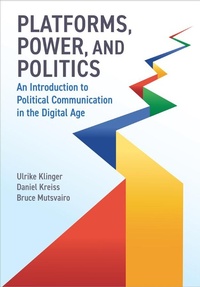
Platforms, Power, and Politics
An Introduction to Political Communication in the Digital Age
Published on 13. October 2023
Book
Hardback
320 pages
978-1-5095-5357-0 (ISBN)
Description
Political Communication has gone through tremendous transformations over the past decades as media and technologies have dramatically changed across the globe. Technology platforms have become powerful political instruments for world leaders, campaigns, social movements, journalists, and non-governmental organizations - central to their attempts to create, persuade, engage, and mobilize publics in pursuit of political power. Platforms are essential to the ways that people communicate about politics, encounter and share political information, and take action to pursue their political goals.
This is the first textbook to center digital platforms in understandings of political communication. It reveals how social media, search engines, messaging services and news portals are increasingly shaping strategic communication, journalism, policymaking, and governing in countries around the world. This book takes a global approach beyond the context of Western democracies to identify diverse yet intersecting examples of media and political developments. It deepens readers' understandings of how the power of platforms in political communication depends on country-specific contexts that shape everything from how elections are contested to how issues make it onto policymaking agendas. Topics covered include public opinion, journalism, strategic communication, political parties and social movements, governance, disinformation and propaganda, populism, race and ethnicity, and democratic backsliding.
Platforms, Power and Politics offers an exciting and innovative new approach to political communication. It will be essential reading for students of political communication as well as being an important resource for scholars, journalists and policymakers.
Political Communication has gone through tremendous transformations over the past decades as media and technologies have dramatically changed across the globe. Technology platforms have become powerful political instruments for world leaders, campaigns, social movements, journalists, and non-governmental organizations - central to their attempts to create, persuade, engage, and mobilize publics in pursuit of political power. Platforms are essential to the ways that people communicate about politics, encounter and share political information, and take action to pursue their political goals.
This is the first textbook to center digital platforms in understandings of political communication. It reveals how social media, search engines, messaging services and news portals are increasingly shaping strategic communication, journalism, policymaking, and governing in countries around the world. This book takes a global approach beyond the context of Western democracies to identify diverse yet intersecting examples of media and political developments. It deepens readers' understandings of how the power of platforms in political communication depends on country-specific contexts that shape everything from how elections are contested to how issues make it onto policymaking agendas. Topics covered include public opinion, journalism, strategic communication, political parties and social movements, governance, disinformation and propaganda, populism, race and ethnicity, and democratic backsliding.
<i>Platforms, Power and Politics</i> offers an exciting and innovative new approach to political communication. It will be essential reading for students of political communication as well as being an important resource for scholars, journalists and policymakers.
This is the first textbook to center digital platforms in understandings of political communication. It reveals how social media, search engines, messaging services and news portals are increasingly shaping strategic communication, journalism, policymaking, and governing in countries around the world. This book takes a global approach beyond the context of Western democracies to identify diverse yet intersecting examples of media and political developments. It deepens readers' understandings of how the power of platforms in political communication depends on country-specific contexts that shape everything from how elections are contested to how issues make it onto policymaking agendas. Topics covered include public opinion, journalism, strategic communication, political parties and social movements, governance, disinformation and propaganda, populism, race and ethnicity, and democratic backsliding.
Platforms, Power and Politics offers an exciting and innovative new approach to political communication. It will be essential reading for students of political communication as well as being an important resource for scholars, journalists and policymakers.
Political Communication has gone through tremendous transformations over the past decades as media and technologies have dramatically changed across the globe. Technology platforms have become powerful political instruments for world leaders, campaigns, social movements, journalists, and non-governmental organizations - central to their attempts to create, persuade, engage, and mobilize publics in pursuit of political power. Platforms are essential to the ways that people communicate about politics, encounter and share political information, and take action to pursue their political goals.
This is the first textbook to center digital platforms in understandings of political communication. It reveals how social media, search engines, messaging services and news portals are increasingly shaping strategic communication, journalism, policymaking, and governing in countries around the world. This book takes a global approach beyond the context of Western democracies to identify diverse yet intersecting examples of media and political developments. It deepens readers' understandings of how the power of platforms in political communication depends on country-specific contexts that shape everything from how elections are contested to how issues make it onto policymaking agendas. Topics covered include public opinion, journalism, strategic communication, political parties and social movements, governance, disinformation and propaganda, populism, race and ethnicity, and democratic backsliding.
<i>Platforms, Power and Politics</i> offers an exciting and innovative new approach to political communication. It will be essential reading for students of political communication as well as being an important resource for scholars, journalists and policymakers.
More details
Edition
1
Language
English
Place of publication
Oxford
United Kingdom
Publishing group
John Wiley and Sons Ltd
Target group
Professional and scholarly
Dimensions
Height: 246 mm
Width: 173 mm
Thickness: 25 mm
Weight
640 gr
ISBN-13
978-1-5095-5357-0 (9781509553570)
Copyright in bibliographic data and cover images is held by Nielsen Book Services Limited or by the publishers or by their respective licensors: all rights reserved.
Schweitzer Classification
Other editions
Additional editions
Ulrike Klinger | Daniel Kreiss | Bruce Mutsvairo
Platforms, Power, and Politics
An Introduction to Political Communication in the Digital Age
Book
10/2023
Polity Press
€24.00
Shipment within 15-20 days
Ulrike Klinger | Daniel Kreiss | Bruce Mutsvairo
Platforms, Power, and Politics
An Introduction to Political Communication in the Digital Age
E-Book
10/2023
1st Edition
Wiley
€18.99
Available for download
Persons
Ulrike Klinger is Professor of Political Theory and Digital Democracy at the European University Viadrina and Associated Researcher at the Weizenbaum Institute for the Networked Society in Berlin.
Daniel Kreiss is the Edgar Thomas Cato Distinguished Professor in the Hussman School of Journalism and Media at the University of North Carolina at Chapel Hill and a principal researcher of the UNC Center for Information, Technology, and Public Life.
Bruce Mutsvairo is a Full Professor and Chair in Media, Politics and the Global South at Utrecht University.
<b>Ulrike Klinger</b> is Professor of Political Theory and Digital Democracy at the European University Viadrina and Associated Researcher at the Weizenbaum Institute for the Networked Society in Berlin.
<b>Daniel Kreiss</b> is the Edgar Thomas Cato Distinguished Professor in the Hussman School of Journalism and Media at the University of North Carolina at Chapel Hill and a principal researcher of the UNC Center for Information, Technology, and Public Life.
<b>Bruce Mutsvairo</b> is a Full Professor and Chair in Media, Politics and the Global South at Utrecht University.
Daniel Kreiss is the Edgar Thomas Cato Distinguished Professor in the Hussman School of Journalism and Media at the University of North Carolina at Chapel Hill and a principal researcher of the UNC Center for Information, Technology, and Public Life.
Bruce Mutsvairo is a Full Professor and Chair in Media, Politics and the Global South at Utrecht University.
<b>Ulrike Klinger</b> is Professor of Political Theory and Digital Democracy at the European University Viadrina and Associated Researcher at the Weizenbaum Institute for the Networked Society in Berlin.
<b>Daniel Kreiss</b> is the Edgar Thomas Cato Distinguished Professor in the Hussman School of Journalism and Media at the University of North Carolina at Chapel Hill and a principal researcher of the UNC Center for Information, Technology, and Public Life.
<b>Bruce Mutsvairo</b> is a Full Professor and Chair in Media, Politics and the Global South at Utrecht University.
Content
Acknowledgments
Chapter 1: Introduction: Political Communication in the Platform Era
Chapter 2: Definitions and Variations of Political Communication
Chapter 3: Platforms and their Power
Chapter 4: Platforms, Public Spheres, and Public Opinion
Chapter 5: Platforms and Journalism
Chapter 6: Platforms and Strategic Political Communication
Chapter 7: Platforms, Campaigns and Campaigning
Chapter 8: Platforms and Movements
Chapter 9: Platform Governance
Chapter 10: Platforms, Misinformation, Disinformation, and Propaganda
Chapter 11: Platforms and Populism, Radicalism, and Extremism
Chapter 12: Platforms, Politics, and Entertainment
Chapter 13: Conclusion: Platforms and the Future of Political Communication
Revision: Chapter Objectives Revisited
References
Index
Chapter 1: Introduction: Political Communication in the Platform Era
Chapter 2: Definitions and Variations of Political Communication
Chapter 3: Platforms and their Power
Chapter 4: Platforms, Public Spheres, and Public Opinion
Chapter 5: Platforms and Journalism
Chapter 6: Platforms and Strategic Political Communication
Chapter 7: Platforms, Campaigns and Campaigning
Chapter 8: Platforms and Movements
Chapter 9: Platform Governance
Chapter 10: Platforms, Misinformation, Disinformation, and Propaganda
Chapter 11: Platforms and Populism, Radicalism, and Extremism
Chapter 12: Platforms, Politics, and Entertainment
Chapter 13: Conclusion: Platforms and the Future of Political Communication
Revision: Chapter Objectives Revisited
References
Index