

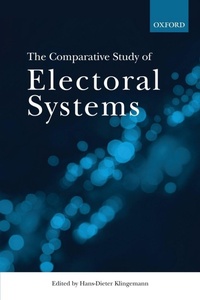
The Comparative Study of Electoral Systems
Published on 16. February 2012
Book
Paperback/Softback
464 pages
978-0-19-964239-7 (ISBN)
Description
Citizens living in presidential or parliamentary systems face different political choices as do voters casting votes in elections governed by rules of proportional representation or plurality. Political commentators seem to know how such rules influence political behaviour. They firmly believe, for example, that candidates running in plurality systems are better known and held more accountable to their constituencies than candidates competing in elections governed by proportional representation. However, such assertions rest on shaky ground simply because solid empirical knowledge to evaluate the impact of political institutions on individual political behaviour is still lacking. The Comparative Study of Electoral Systems has collected data on political institutions and on individual political behaviour and scrutinized it carefully. In line with common wisdom results of most analyses presented in this volume confirm that political institutions matter for individual political behaviour but, contrary to what is widely believed, they do not matter much.
More details
Series
Language
English
Place of publication
Oxford
United Kingdom
Target group
College/higher education
Professional and scholarly
Dimensions
Height: 234 mm
Width: 156 mm
Thickness: 24 mm
Weight
679 gr
ISBN-13
978-0-19-964239-7 (9780199642397)
Copyright in bibliographic data and cover images is held by Nielsen Book Services Limited or by the publishers or by their respective licensors: all rights reserved.
Schweitzer Classification
Other editions
Additional editions
Hans-Dieter Klingemann
The Comparative Study of Electoral Systems
Book
02/2009
Oxford University Press
€91.60
Shipment within 15-20 days
Person
Hans-Dieter Klingemann earned his academic degrees from the University of Cologne (1966: Dr. rer. pol.) and from the University of Mannheim (1978: Dr. habil.). He has held academic positions at the University of Cologne (1966-74), the Center for Survey Research (ZUMA), Mannheim (1974-80), the Free University of Berlin (1980-2002), and the Social Science Research Center Berlin (1989-2003). In the profession Professor Klingemann has served as Vice-President (1982/83) and President of the International Society of Political Psychology (1986/87), as member of the Executive Committee of the European Consortium for Political Research (1988/94), as Vice-President of the International Political Science Association (1994/97), as President of the German Paul Lazarsfeld-Society (1994/99), and as President of the European Political Science Network (2002-2005).
Content
PART I INTRODUCTION ; PART II THE PROJECT ; PART III ELECTORAL PARTICIPATION ; PART IV POLITICAL PARTIES, CANDIDATES, AND ISSUES ; PART V EXPRESSIVE AND INSTRUMENTAL VOTING ; PART VI POLITICAL SUPPORT