

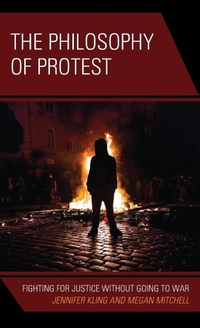
The Philosophy of Protest
Fighting for Justice without Going to War
Published on 9. November 2021
Book
Hardback
182 pages
978-1-78661-320-2 (ISBN)
Description
Protest is a critical part of the contemporary political landscape. Despite the prevalence of protest as a real-world practice, most liberal political theory limits its focus on protest to ideal conditions. This book takes up the question of how to think about protest, from within the context of liberal political theory, in the face of serious, substantial, ongoing, and actual injustices-in short, a theory of protest for our world. What can or must protest include? What, if anything, must it avoid? Against much of the popular discourse, the authors defend the view that suitably constrained violent political protest is sometimes justified. Violent political protest is not simply revolution by any other name-it's a last-ditch effort to remedy injustice without going to war.
Reviews / Votes
It is often argued that political protest is legitimate only if it is non-violent, a view often attributed wrongly to Mahatma Gandhi, Martin Luther King, Jr., and/or Henry David Thoreau. When some of the Black Lives Matter protests turned violent, Kling and Mitchell, like many, found themselves wondering if this could be justified. Their book explores the ethical foundations of such wondering and concludes that political violence is sometimes justified and is not always inconsistent with the principles of liberal democracy. The argument against violent acts is that they forestall the possibility of resolving conflicts through communication. The authors counter that violence-they exclude lethal violence-may sometimes be needed to assert the right of an oppressed group to enter into such communication. They ground their argument in a comprehensive survey of contemporary ethical scholarship, particularly but not exclusively by scholars influenced by the work of John Rawls. They also seek a philosophical distinction between revolutionary and non-revolutionary protest, since most people would expect states to suppress violent revolutionary protest with force. The book is conversational in tone and would foster good discussion among undergraduate philosophy students. Recommended. General readers and advanced undergraduates through faculty. * Choice Reviews *More details
Language
English
Place of publication
United Kingdom
Publishing group
Bloomsbury Publishing PLC
Target group
Professional and scholarly
US School Grade: Up to College Graduate Student
Dimensions
Height: 222 mm
Width: 145 mm
Thickness: 14 mm
Weight
368 gr
ISBN-13
978-1-78661-320-2 (9781786613202)
Copyright in bibliographic data and cover images is held by Nielsen Book Services Limited or by the publishers or by their respective licensors: all rights reserved.
Schweitzer Classification
Other editions
Additional editions
E-Book
11/2021
1st Edition
Rowman & Littlefield Publishers
€33.49
Available for download
Persons
Jennifer Kling is assistant professor of philosophy and director of the Center for Legal Studies at the University of Colorado, Colorado Springs. Her research focuses on moral and political philosophy, particularly issues in war and peace, self- and other-defense, international relations, protest, and feminism. She is the author of War Refugees: Risk, Justice, and Moral Responsibility (Lexington, 2019) as well as numerous articles in academic journals and edited collections.
Megan Mitchell is associate professor of philosophy at Stonehill College in North Easton, Massachusetts, where she teaches classes in philosophy of race, feminism, and African philosophy. Her work is in political philosophy, particularly issues of race and racism. She has authored articles in Dialogue: Canadian Philosophical Review, Ethical Theory and Moral Practice, Radical Philosophy Review, and Pacifism, Politics, and Feminism: Intersections and Innovations (2019).
Megan Mitchell is associate professor of philosophy at Stonehill College in North Easton, Massachusetts, where she teaches classes in philosophy of race, feminism, and African philosophy. Her work is in political philosophy, particularly issues of race and racism. She has authored articles in Dialogue: Canadian Philosophical Review, Ethical Theory and Moral Practice, Radical Philosophy Review, and Pacifism, Politics, and Feminism: Intersections and Innovations (2019).
Content
Preface
1. A Brief (Philosophical) History of Protest and Liberalism
I. Common Liberal Categories of Resistance and Protest
II. Pressing the Liberal Tradition
III. Moving Forward: Reimagining Liberalism
2. Bottles and Bricks: Rethinking the Prohibition against Violent Protest
I. The Conceptual Argument
II. Moral Considerations
III. Pragmatic Considerations
3. (Re)Considering Violence
I. An Ordinary Conception of Violence
I.a. Subjectivity and Ideology
II. Challenging an Ordinary Conception
II.a. Violence as a Rights Violation
II.b. Structural Violence
II.c. Violence as a Violation of Integrity
III. Return to Milkshaking
4. Violence as Persuasive Political Communication
I. Progressing Towards Justice
II. A Commitment to the Political
III. Interpersonal Violence as Moral and Political Suasion
5. Responsibility and Accountability: Permission for Violent Protest
I. The Political Responsibility to Oppose Injustice
II. The Nature of the Political Responsibility to Protest
III. Evaluating P
1. A Brief (Philosophical) History of Protest and Liberalism
I. Common Liberal Categories of Resistance and Protest
II. Pressing the Liberal Tradition
III. Moving Forward: Reimagining Liberalism
2. Bottles and Bricks: Rethinking the Prohibition against Violent Protest
I. The Conceptual Argument
II. Moral Considerations
III. Pragmatic Considerations
3. (Re)Considering Violence
I. An Ordinary Conception of Violence
I.a. Subjectivity and Ideology
II. Challenging an Ordinary Conception
II.a. Violence as a Rights Violation
II.b. Structural Violence
II.c. Violence as a Violation of Integrity
III. Return to Milkshaking
4. Violence as Persuasive Political Communication
I. Progressing Towards Justice
II. A Commitment to the Political
III. Interpersonal Violence as Moral and Political Suasion
5. Responsibility and Accountability: Permission for Violent Protest
I. The Political Responsibility to Oppose Injustice
II. The Nature of the Political Responsibility to Protest
III. Evaluating P