

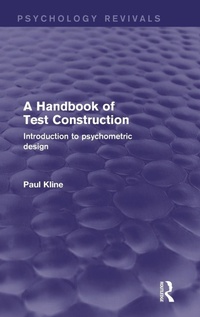
A Handbook of Test Construction
Introduction to Psychometric Design
1st Edition
Published on 26. March 2015
Book
Hardback
260 pages
978-1-138-90511-5 (ISBN)
Description
Psychological tests provide reliable and objective standards by which individuals can be evaluated in education and employment. Therefore accurate judgements must depend on the reliability and quality of the tests themselves. Originally published in 1986, this handbook by an internationally acknowledged expert provided an introductory and comprehensive treatment of the business of constructing good tests.
Paul Kline shows how to construct a test and then to check that it is working well. Covering most kinds of tests, including computer presented tests of the time, Rasch scaling and tailored testing, this title offers: a clear introduction to this complex field; a glossary of specialist terms; an explanation of the objective of reliability; step-by-step guidance through the statistical procedures; a description of the techniques used in constructing and standardizing tests; guidelines with examples for writing the test items; computer programs for many of the techniques.
Although the computer testing will inevitably have moved on, students on courses in occupational, educational and clinical psychology, as well as in psychological testing itself, would still find this a valuable source of information, guidance and clear explanation.
Paul Kline shows how to construct a test and then to check that it is working well. Covering most kinds of tests, including computer presented tests of the time, Rasch scaling and tailored testing, this title offers: a clear introduction to this complex field; a glossary of specialist terms; an explanation of the objective of reliability; step-by-step guidance through the statistical procedures; a description of the techniques used in constructing and standardizing tests; guidelines with examples for writing the test items; computer programs for many of the techniques.
Although the computer testing will inevitably have moved on, students on courses in occupational, educational and clinical psychology, as well as in psychological testing itself, would still find this a valuable source of information, guidance and clear explanation.
More details
Series
Language
English
Place of publication
London
United Kingdom
Publishing group
Taylor & Francis Ltd
Target group
College/higher education
Professional and scholarly
Dimensions
Height: 240 mm
Width: 161 mm
Thickness: 19 mm
Weight
578 gr
ISBN-13
978-1-138-90511-5 (9781138905115)
Copyright in bibliographic data and cover images is held by Nielsen Book Services Limited or by the publishers or by their respective licensors: all rights reserved.
Schweitzer Classification
Other editions
Additional editions
Book
09/2016
1st Edition
Routledge
€83.70
Shipment within 10-20 days
E-Book
06/2015
Routledge
€77.99
Available for download
E-Book
06/2015
Routledge
€77.99
Available for download
Person
Kline, Paul
Content
Preface. Glossary of Terms. 1. The Characteristics of Good Tests in Psychology 2. Making Tests Reliable I: Intelligence and Ability. Item Writing 3. Making Tests Reliable II: Personality Inventories. Item Writing 4. Making Tests Reliable III: Constructing Other Types of Test 5. Computing Test-Reliability 6. Item Trials 7. Computing the Discriminatory Power and the Validity of Tests 8. Standardizing the Test 9. Other Methods of Test Construction 10. Computerized Testing, Tailored Testing, Rasch Scaling and Cognitive Process Studies 11. Summary and Conclusions. Appendix 1: Item-analysis programs. Appendix 2: Using the Programs. Bibliography. Name Index. Subject Index.