

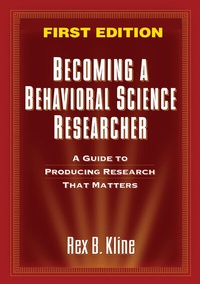
Becoming a Behavioral Science Researcher, First Edition
A Guide to Producing Research that Matters
1st Edition
Published on 30. September 2008
Book
Paperback/Softback
367 pages
978-1-59385-837-7 (ISBN)
Description
Students and beginning researchers often discover that their introductory statistics and methods courses have not fully equipped them to plan and execute their own behavioral research studies. This indispensable book bridges the gap between coursework and conducting independent research. With clarity and wit, the author helps the reader build needed skills to formulate a precise, meaningful research question; understand the pros and cons of widely used research designs and analysis options; correctly interpret the outcomes of statistical tests; make informed measurement choices for a particular study; manage the practical aspects of data screening and preparation; and craft effective journal articles, oral presentations, and posters. Including annotated examples and recommended readings, most chapters feature theoretical and computer-based exercises; an answer appendix at the back of the book allows readers to check their work.
Reviews / Votes
"Outstanding! Kline is masterful in helping to fill the sometimes cavernous gap between research coursework and applied practice. The focus on modern approaches, including emphasis on replication and effect sizes, represents a new (and needed) generation of research texts, which will benefit advanced undergraduate and graduate students alike in their research courses and seminars. The book honestly and artfully walks the fine line between applied accessibility and necessary depth of content."--Robin K. Henson, PhD, Department of Educational Psychology, University of North Texas"Many beginning graduate students find that conventional statistics and methods courses do not give them enough of the practical skills in data analysis, interpretation, and oral and written communication that they need to succeed. Kline has given us a wonderfully wise guide to these skills. This book is beautifully written, entirely practical, and includes the latest statistical approaches. It is essential reading for anyone who wishes to become a successful behavioral science researcher today."--Geoff Cumming, DPhil, School of Psychological Science (Emeritus), La Trobe University, Australia
"A book designed to improve the quality of behavioral and social science research and the way in which it is communicated. I would strongly recommend this text for use in both undergraduate and graduate research methods courses. It offers students a glimpse of many important issues in the field. In particular, the emphasis on, and presentation of, measurement and statistics reform should truly benefit students. This book is a valuable resource for anyone who intends to pursue a career in the behavioral or social sciences."--Chris L. S. Coryn, PhD, Director, Interdisciplinary PhD Program in Evaluation, The Evaluation Center, Western Michigan University
"This book could be used in a graduate seminar that has the goals of bridging the gap between statistics and methods courses and preparing students to conduct good research. I appreciated the section on data screening--a crucial topic--and found the author's treatment of how to write each section of an empirical paper quite valuable. The APA style manual is not nearly as instructive. This text is the kind of book that you keep; it would serve as a handy reference."--Theresa DiDonato, doctoral candidate, Department of Psychology, Brown University
"This is more than a textbook; it is a portable mentor! Kline brings his considerable knowledge and approachable style to the aid of advanced undergraduates and graduate students alike. The book addresses so many issues that fall through the cracks in our fragmented coursework, such as the general integration of design, measurement, and analysis. I would be remiss if I did not make this mandatory reading for all of my students."--Gregory R. Hancock, PhD, Professor and Chair, Department of Measurement, Statistics and Evaluation, University of Maryland, College Park
"Kline has written the finest synthesis of initiating and finishing research for graduate students that I have read. It is comprehensive, integrative, and couched at a level that will engage students in the research process. I wish I'd had this book when I was first starting out. This text could be used in a proseminar or basic research methods course for first-year graduate students, an honors undergraduate class, or an upper-division thesis course."--William R. Shadish, PhD, Chair, Psychological Sciences Section, University of California, Merced
"This book helps me sell research to my students and present the big picture like no other methods text I've seen. It not only covers basic research designs and methods, but also provides the most current treatment of effect sizes, meta-analysis, and the paradigmatic shift from significance tests to model fitting--all within a painfully honest critique of the limits of research as currently conducted and published, and what social scientists need to do to improve it. Like Kline's book on structural equation modeling (which was all I needed to learn SEM), this book is crystal clear and engaging. Yet what makes it most unique and essential for my students is its synthetic approach and attention to the big issues. This is what I most want my students to learn. They can easily find more information about specific designs and sampling techniques, but if they don't 'get' research--its purpose, meaning, and importance--then I haven't done my job."--Michael J. Karcher, EdD, PhD, Department of Counseling, University of Texas at San Antonio "This book helps me sell research to my students and present the big picture like no other methods text I've seen. It not only covers basic research designs and methods, but also provides the most current treatment of effect sizes, meta-analysis, and the paradigmatic shift from significance tests to model fitting - all within a painfully honest critique of the limits of research as currently conducted and published, and what social scientists need to do to improve it. Like Kline's book on structural equation modeling (which was all I needed to learn SEM), this book is crystal clear and engaging. Yet what makes it most unique and essential for my students is its synthetic approach and attention to the big issues. This is what I most want my students to learn. They can easily find more information about specific designs and sampling techniques, but if they don't 'get' research - its purpose, meaning, and importance - then I haven't done my job." - Michael J. Karcher, Department of Counseling, University of Texas at San Antonio, USA
"Even the most informed psychologist is likely to learn something by reading this book. ... A superb resource for students and teachers alike. ... It would enhance any psychology curriculum and help the students of today become first-rate researchers of tomorrow." - APA PsycCRITIQUES
"Kline has written the finest synthesis of getting started and finishing research for graduate students that I have read. It is comprehensive, integrative, and couched at a level that will engage students in the research process. I wish I'd had this book when I was first starting out." - William R. Shadish, Chair, Psychological Sciences Section, University of California, Merced, USA
"A book designed to improve the quality of behavioral and social science research and the way in which it is communicated. I would strongly recommend this text for use in both undergraduate and graduate research methods courses. It offers students a glimpse of many important issues in the field. In particular, the emphasis on, and presentation of, measurement and statistics reform should truly benefit students. This book is a valuable resource for anyone who intends to pursue a career in the behavioral or social sciences." - Chris L. S. Coryn, Director, Interdisciplinary PhD Program in Evaluation, The Evaluation Center, Western Michigan University, USA
"I appreciated the section on data screening - a crucial topic - and found the author's treatment of how to write each section of an empirical paper quite valuable. The APA style manual is not nearly as instructive. This text is the kind of book that you keep; it would serve as a handy reference." - Theresa DiDonato, doctoral candidate, Department of Psychology, Brown University, USA
"This is more than a textbook; it is a portable mentor! Kline brings his considerable knowledge and approachable style to the aid of advanced undergraduates and graduate students alike. The book addresses so many issues that fall through the cracks in our fragmented coursework, such as the general integration of design, measurement, and analysis. I would be remiss if I did not make this mandatory reading for all of my students." - Gregory R. Hancock, Professor and Chair, Department of Measurement, Statistics and Evaluation, University of Maryland, College Park, USA
"Many beginning graduate students find that conventional statistics and methods courses do not give them enough of the practical skills in data analysis, interpretation, and oral and written communication that they need to succeed. Kline has given us a wonderfully wise guide to these skills. This book is beautifully written, entirely practical, and includes the latest statistical approaches. It is essential reading for anyone who wishes to become a successful behavioral science researcher today." - Geoff Cumming, School of Psychological Science (Emeritus), La Trobe University, Australia
"Outstanding! Kline is masterful in helping to fill the sometimes cavernous gap between research coursework and applied practice. The focus on modern approaches, including emphasis on replication and effect sizes, represents a new (and needed) generation of research texts, which will benefit advanced undergraduate and graduate students alike in their research courses and seminars. The book honestly and artfully walks the fine line between applied accessibility and necessary depth of content." - Robin K. Henson, Department of Educational Psychology, University of North Texas, USA
More details
Language
English
Place of publication
New York
United States
Target group
Professional and scholarly
College/higher education
Dimensions
Height: 229 mm
Width: 152 mm
Weight
528 gr
ISBN-13
978-1-59385-837-7 (9781593858377)
Copyright in bibliographic data and cover images is held by Nielsen Book Services Limited or by the publishers or by their respective licensors: all rights reserved.
Schweitzer Classification
Other editions
New editions
Rex B. Kline
Becoming a Behavioral Science Researcher, Second Edition
A Guide to Producing Research That Matters
Book
12/2019
2nd Edition
Guilford Press
€56.00
Shipment within 15-20 days
Additional editions
Rex B. Kline
Becoming a Behavioral Science Researcher, First Edition
A Guide to Producing Research that Matters
Book
09/2008
1st Edition
Guilford Publications
€103.07
Article exhausted; check for reprint
Person
Rex B. Kline, PhD, is Professor of Psychology at Concordia University in Montreal. Since earning a doctorate in clinical psychology, he has conducted research on the psychometric evaluation of cognitive abilities, behavioral and scholastic assessment of children, structural equation modeling, training of researchers, statistics reform in the behavioral sciences, and usability engineering in computer science. Dr. Kline has published a number of books, chapters, and journal articles in these areas. His website is http://tinyurl.com/rexkline.
Content
I. PROMISE AND PROBLEMS
1. Introduction
Not Ready for Prime Time
What Students Say They Need
Plan of the Book
Career Paths for Behavioral Scientists
Summary
Recommended Readings
2. The Good, the Bad, and (the Really) Ugly of Behavioral Science Research
The Good
The Bad
The (Really) Ugly
Why?
Summary
Recommended Readings
II. CONCEPTS
3. The Research Trinity
Trinity Overview
Design
Measurement
Analysis
Internal Validity
Construct Validity
Conclusion Validity
External Validity and Sampling
Summary
Recommended Readings
Exercises
4. Design and Analysis
Chapter Overview
From Question to Design
Experimental Designs
Controlled Quasi-Experimental Designs
Nonequivalent-Group Designs
Regression-Discontinuity Designs
Other Quasi-Experimental Designs
Nonexperimental Designs
Resources for Learning More
Summary
Recommended Readings
Exercises
5. The Truth about Statistics
Study Strategy
A Dozen Truths about Statistics
What Statistical Significance Really Means
Misinterpretations of Statistical Significance
Why Are There So Many Myths?
Other Drawbacks of Statistical Tests
In Defense of Statistical Tests
Recommendations for Changing Times
Summary
Recommended Readings
Exercises
Appendix 5.1. Review of Statistics Fundamentals
6. Effect Size Estimation
Contexts for Estimating Effect Size
Families of Parametric Effect Sizes
Estimating Effect Size When Comparing Two Samples
Measures of Association for More Complex Designs
Effect Sizes for Dichotomous Outcomes
T-Shirt Effect Sizes, Importance, and Cautions
Approximate Confidence Intervals
Research Examples
Summary
Recommended Readings
Exercises
Appendix 6.1. Noncentrality Interval Estimation for Effect Sizes
7. Measurement
Chapter Scope
The Critical Yet Underappreciated Role of Measurement
Measurement Process Overview
Resources for Finding Measures
Adapting or Translating Tests
Evaluation of Score Reliability and Validity
Checklist for Evaluating Measures
Recent Developments in Test Theory
Summary
Recommended Readings
Exercises
III. SKILLS
8. Practical Data Analysis
Vision First, Then Simplicity
Managing Complex Analyses (Batch to the Future)
Data Screening
Summary
Recommended Readings
Exercises
9. Writing
Plagiarism and Academic Integrity
Writing as Learning
Getting Started
The Role of Style Guides
General Principles of Good Writing
Principles of Good Scientific Writing
Writing Sections of Empirical Studies
Effective Graphical Displays
Ready for the Big Time
Summary
Recommended Readings
Appendix 9.1. Example Results Section
10. Presentations
Challenges of Oral Presentations
Problems with PowerPoint Presentations
Principles for Creating Effective PowerPoint Presentations
Lessons from Multimedia Learning
Other PowerPoint Issues
Poster Presentations
Summary
Recommended Readings
Exercises
Appendix 10.1. 4-Color Example Slides, Handout, and Poster
Suggested Answers to Exercises
1. Introduction
Not Ready for Prime Time
What Students Say They Need
Plan of the Book
Career Paths for Behavioral Scientists
Summary
Recommended Readings
2. The Good, the Bad, and (the Really) Ugly of Behavioral Science Research
The Good
The Bad
The (Really) Ugly
Why?
Summary
Recommended Readings
II. CONCEPTS
3. The Research Trinity
Trinity Overview
Design
Measurement
Analysis
Internal Validity
Construct Validity
Conclusion Validity
External Validity and Sampling
Summary
Recommended Readings
Exercises
4. Design and Analysis
Chapter Overview
From Question to Design
Experimental Designs
Controlled Quasi-Experimental Designs
Nonequivalent-Group Designs
Regression-Discontinuity Designs
Other Quasi-Experimental Designs
Nonexperimental Designs
Resources for Learning More
Summary
Recommended Readings
Exercises
5. The Truth about Statistics
Study Strategy
A Dozen Truths about Statistics
What Statistical Significance Really Means
Misinterpretations of Statistical Significance
Why Are There So Many Myths?
Other Drawbacks of Statistical Tests
In Defense of Statistical Tests
Recommendations for Changing Times
Summary
Recommended Readings
Exercises
Appendix 5.1. Review of Statistics Fundamentals
6. Effect Size Estimation
Contexts for Estimating Effect Size
Families of Parametric Effect Sizes
Estimating Effect Size When Comparing Two Samples
Measures of Association for More Complex Designs
Effect Sizes for Dichotomous Outcomes
T-Shirt Effect Sizes, Importance, and Cautions
Approximate Confidence Intervals
Research Examples
Summary
Recommended Readings
Exercises
Appendix 6.1. Noncentrality Interval Estimation for Effect Sizes
7. Measurement
Chapter Scope
The Critical Yet Underappreciated Role of Measurement
Measurement Process Overview
Resources for Finding Measures
Adapting or Translating Tests
Evaluation of Score Reliability and Validity
Checklist for Evaluating Measures
Recent Developments in Test Theory
Summary
Recommended Readings
Exercises
III. SKILLS
8. Practical Data Analysis
Vision First, Then Simplicity
Managing Complex Analyses (Batch to the Future)
Data Screening
Summary
Recommended Readings
Exercises
9. Writing
Plagiarism and Academic Integrity
Writing as Learning
Getting Started
The Role of Style Guides
General Principles of Good Writing
Principles of Good Scientific Writing
Writing Sections of Empirical Studies
Effective Graphical Displays
Ready for the Big Time
Summary
Recommended Readings
Appendix 9.1. Example Results Section
10. Presentations
Challenges of Oral Presentations
Problems with PowerPoint Presentations
Principles for Creating Effective PowerPoint Presentations
Lessons from Multimedia Learning
Other PowerPoint Issues
Poster Presentations
Summary
Recommended Readings
Exercises
Appendix 10.1. 4-Color Example Slides, Handout, and Poster
Suggested Answers to Exercises