

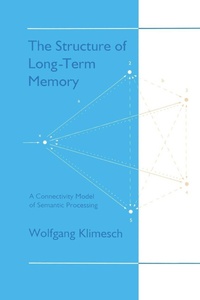
The Structure of Long-term Memory
A Connectivity Model of Semantic Processing
1st Edition
Published on 7. May 2015
Book
Paperback/Softback
248 pages
978-1-138-87638-5 (ISBN)
Description
How is information stored and retrieved from long-term memory? It is argued that any systematic attempt to answer this question should be based on a particular set of specific representational assumptions that have led to the development of a new memory theory -- the connectivity model. One of the crucial predictions of this model is that, in sharp contrast to traditional theories, the speed of processing information increases as the amount and complexity of integrated knowledge increases. In this volume, the predictions of the model are examined by analyzing the results of a variety of different experiments and by studying the outcome of the simulation program CONN1, which illustrates the representation of complex semantic structures. In the final chapter, the representational assumptions of the connectivity model are evaluated on the basis of neuroanatomical and physiological evidence -- suggesting that neuroscience provides valuable knowledge which should guide the development of memory theories.
More details
Language
English
Place of publication
Hove
United Kingdom
Publishing group
Taylor & Francis Ltd
Target group
Professional and scholarly
Dimensions
Height: 229 mm
Width: 152 mm
Thickness: 14 mm
Weight
365 gr
ISBN-13
978-1-138-87638-5 (9781138876385)
Copyright in bibliographic data and cover images is held by Nielsen Book Services Limited or by the publishers or by their respective licensors: all rights reserved.
Schweitzer Classification
Other editions
Additional editions
E-Book
05/2013
1st Edition
Psychology Press Ltd
€78.99
Available for download

E-Book
05/2013
1st Edition
Psychology Press Ltd
€78.99
Available for download

Book
03/1994
1st Edition
Psychology Press
€206.40
Shipment within 10-20 days
Person
Klimesch, Wolfgang
Content
Contents: Preface. Introduction. The Representational Problem: A Historical Perspective. Traditional Theories of Forgetting. The Failure of Traditional Forgetting Theories: Misleading Representational Assumptions. STM Codes: Their Structure and Decay. Network Theories: Basic Assumptions on the Structure of LTM. Strictly and Nonstrictly Hierarchical Models of Fact Retrieval. Strictly and Nonstrictly Hierarchical Models of Word Meaning. The Connectivity Model. A Connectivity Model for Semantic Processing. The Simulation Program CONN1. Representational Assumptions and Their Possible Neural Bases. Concluding Remarks.