

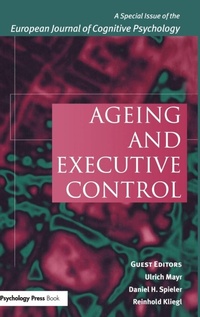
Ageing and Executive Control
A Special Issue of the European Journal of Cognitive Psychology
Published on 14. June 2001
Book
Hardback
310 pages
978-1-84169-908-0 (ISBN)
Description
The empirical and theoretical analysis of executive control processes, dormant for many years, has grown to become one of the most fertile areas of research in cognitive psychology and cognitive neuroscience. Because executive functions are thought to have a pervasive role in maintaining optimal information processing across many processing situations, issues related to executive control cut across many traditional research divides. Unique among many other areas of research in cognition, questions about the influence of ageing have figured prominently in executive control research. There is accumulating evidence of age-related changes in frontal/executive functions. The union of research on executive functioning with research on the cognitive effects of ageing could provide the theoretical framework for understanding the widespread influence of ageing on cognition.
This special issue brings together well-known researchers in cognitive psychology and cognitive neuroscience who approach the question of executive control using a wide range of methods from traditional behavioural studies, quantitative and computational modelling, and functional neuroimaging. The emphasis of these contributions is on a concise overview and integration of relevant theoretical ideas and empirical findings. By bringing together a diverse group of contributors, this special issue can serve researchers and students both as a summary of current research and as a starting point toward further explorations on the relations between executive control and the cognitive influences of ageing.
This special issue brings together well-known researchers in cognitive psychology and cognitive neuroscience who approach the question of executive control using a wide range of methods from traditional behavioural studies, quantitative and computational modelling, and functional neuroimaging. The emphasis of these contributions is on a concise overview and integration of relevant theoretical ideas and empirical findings. By bringing together a diverse group of contributors, this special issue can serve researchers and students both as a summary of current research and as a starting point toward further explorations on the relations between executive control and the cognitive influences of ageing.
More details
Series
Language
English
Place of publication
Hove
United Kingdom
Publishing group
Taylor & Francis Ltd
Target group
College/higher education
Professional and scholarly
Dimensions
Height: 240 mm
Width: 161 mm
Thickness: 21 mm
Weight
631 gr
ISBN-13
978-1-84169-908-0 (9781841699080)
Copyright in bibliographic data and cover images is held by Nielsen Book Services Limited or by the publishers or by their respective licensors: all rights reserved.
Schweitzer Classification
Other editions
Additional editions
Reinhold Kliegl | Ulrich Mayr-Psycholgy | Daniel Spieler
Ageing and Executive Control
A Special Issue of the European Journal of Cognitive Psychology
Book
02/2019
1st Edition
Psychology Press Ltd
€46.50
Shipment within 10-20 days
Persons
Ulrich Mayr, University of Oregon, Eugene, USA. Daniel H. Spieler Stanford University, CA, USA. Reinhold Kliegl, University of Potsdam, Germany.
Content
Introduction; Frontal tests and models for cognitive ageing; A research strategy for investigating group differences in a cognitive construct: Application to ageing and executive processes; Is there an age deficit in the selection of mental sets? Adult age differences in goal activation and goal maintenance; The transient nature of executive control processes in younger and older Adults; Inhibitory control over the present and the past; Executive-process interactive control: A unified computational theory for answering 20 questions (and more) about cognitive ageing; Modelling cognitive control in task switching and ageing; Beyond resources: Formal models of complexity effects and age differences in working memory; Modelling age-related changes in information processing; Age-related changes in brain-behaviour relationships: Evidence from event-related functional MRI studies; Neurocognitive ageing and storage of executive processes; The impact of aerobic activity on cognitive function in older adults: A new synthesis based on the concept of executive control