

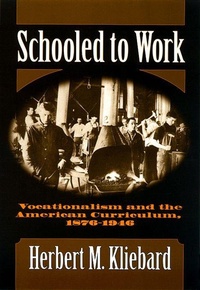
Schooled to Work
Vocationalism and the American Curriculum, 1876-1946
Will be published approx. on 9. April 1999
Book
Paperback/Softback
312 pages
978-0-8077-3866-5 (ISBN)
Description
In this trenchant interpretation of the rise of vocational education, Herbert M. Kliebard explains how Americans turned to public schools for answers to the problems of an increasingly urban, industrial society. Tracing the evolution of job training as an educational ideal, Kliebard analyzes the construction of vocationalism through three overlapping but distinctive stages. In the first stage, manual training is promoted as a pedagogical reform and moral corrective. In the second stage, vocational training for the new industrial workplace emerges as a major component of the American curriculum and contributes to its bifurcation. In the final stage, preparation to enter the workforce begins to eclipse other educational purposes. Concluding with a Deweyan critique of vocationalism, this book offers a much-needed perspective with which to view current debates about the meaning of public education and the transition from "school to work."
More details
Series
Language
English
Place of publication
New York
United States
Target group
Professional and scholarly
Product notice
Paperback (trade)
Unsewn / adhesive bound
Illustrations
Illustrations, 1 port.
Dimensions
Height: 228 mm
Width: 157 mm
Thickness: 17 mm
Weight
408 gr
ISBN-13
978-0-8077-3866-5 (9780807738665)
Copyright in bibliographic data and cover images is held by Nielsen Book Services Limited or by the publishers or by their respective licensors: all rights reserved.
Schweitzer Classification