

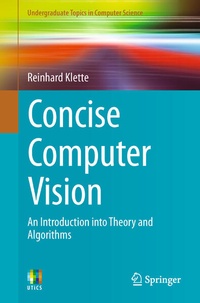
Concise Computer Vision
An Introduction into Theory and Algorithms
Published on 20. January 2014
Book
Paperback/Softback
XVIII, 429 pages
978-1-4471-6319-0 (ISBN)
Description
This textbook provides an accessible general introduction to the essential topics in computer vision. Classroom-tested programming exercises and review questions are also supplied at the end of each chapter. Features: provides an introduction to the basic notation and mathematical concepts for describing an image and the key concepts for mapping an image into an image; explains the topologic and geometric basics for analysing image regions and distributions of image values and discusses identifying patterns in an image; introduces optic flow for representing dense motion and various topics in sparse motion analysis; describes special approaches for image binarization and segmentation of still images or video frames; examines the basic components of a computer vision system; reviews different techniques for vision-based 3D shape reconstruction; includes a discussion of stereo matchers and the phase-congruency model for image features; presents an introduction into classification and learning.
More details
Series
Edition
2014 ed.
Language
English
Place of publication
London
United Kingdom
Target group
Upper undergraduate
Illustrations
69 s/w Abbildungen, 229 farbige Abbildungen
XVIII, 429 p. 298 illus., 229 illus. in color.
Dimensions
Height: 235 mm
Width: 155 mm
Thickness: 23 mm
Weight
756 gr
ISBN-13
978-1-4471-6319-0 (9781447163190)
DOI
10.1007/978-1-4471-6320-6
Schweitzer Classification
Other editions
New editions

Book
06/2019
2nd Edition
Springer
€53.49
The article will not be published
Additional editions
E-Book
01/2014
Springer
€48.14
Available for download
Person
Dr. Reinhard Klette
, FRSNZ, is a Professor at the Tamaki Innovation Campus of The University of Auckland, New Zealand. His numerous other publications include the Springer title
Euclidean Shortest Paths: Exact or Approximate Algorithms
.
Content
1: Image Data.- 2: Image Processing.- 3: Image Analysis.- 4: Dense Motion Analysis.- 5: Image Segmentation.- 6: Cameras, Coordinates and Calibration.- 7: 3D Shape Reconstruction.- 8: Stereo Matching.- 9: Feature Detection and Tracking.- 10: Object Detection.