

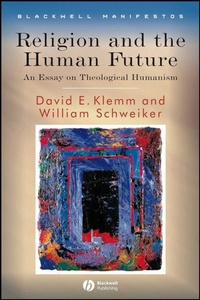
Religion and the Human Future
An Essay on Theological Humanism
1st Edition
Published on 22. August 2008
Book
Paperback/Softback
216 pages
978-1-4051-5527-4 (ISBN)
Description
This powerful manifesto outlines a vision called theological humanism based on the idea that that the integrity of life provides a way to articulate the meaning of religion for the human future.
Explores a profound quest to understand the meaning and responsibility of our shared and yet divided humanity amidst the uncertainty of modern society
Articulates the idea that human beings are mixed creatures striving for integrity not only trying to conform to God's will
Sets forth a dynamic and robust vision of human life beyond the divisions that haunt the humanities, social sciences, theology, and religious studies
Explores a profound quest to understand the meaning and responsibility of our shared and yet divided humanity amidst the uncertainty of modern society
Articulates the idea that human beings are mixed creatures striving for integrity not only trying to conform to God's will
Sets forth a dynamic and robust vision of human life beyond the divisions that haunt the humanities, social sciences, theology, and religious studies
Reviews / Votes
"There is no doubt this is a great book. . . the place to finish this review is with admiration and respect. This book will shape key debates for many years to come. It is a remarkably clear statement of a program and vision, which stresses integrity, reason, and generosity. For this service to the church and the academy, we should be deeply grateful." (Conversations in Religion and Theology, November 2010)"Religion and the Human Future provides an excellent, well thought-out and well documented analysis of the current dilemma facing religions and religious people: the human dangers and inadequacies of hypertheism, with its exaggerated response to the challenge of modernity and over humanization, with its overly unreflective veneration for modernity." (Ethical Perspectives, July 2010)"This text sounds a clarion call to change the debate about the role of religion in human life. ... With limited endnotes and an engaging style, this carefully argued text mostly succeeds in its attempt to be accessible to a wider audience that could include upperlevel undergraduates." (Religious Studies Review, September 2009)
More details
Series
Language
English
Place of publication
Hoboken
United Kingdom
Publishing group
John Wiley and Sons Ltd
Target group
Professional and scholarly
Product notice
Paperback (trade)
Unsewn / adhesive bound
Dimensions
Height: 229 mm
Width: 152 mm
Thickness: 16 mm
Weight
340 gr
ISBN-13
978-1-4051-5527-4 (9781405155274)
Copyright in bibliographic data and cover images is held by Nielsen Book Services Limited or by the publishers or by their respective licensors: all rights reserved.
Schweitzer Classification
Other editions
Additional editions
E-Book
01/2009
Wiley-Blackwell
€35.99
Available for download
Book
09/2008
1st Edition
Wiley
€99.50
Article not available at the moment
Persons
David E. Klemm is a Professor in the Department of Religious Studies at The University of Iowa. He is the author of a number of books, including Hermeneutical Inquiry, volumes I and II (1986), The Hermeneutical Theory of Paul Ricoeur: A Constructive Analysis (1983), and is co-editor of Figuring the Self: Subject, Absolute, and Others in Classical German Philosophy (1997), and Meanings in Texts and Actions: Questioning Paul Ricoeur (1993). William Schweiker is Edward L. Ryerson Distinguished Service Professor of Theological Ethics at the University of Chicago and Director of the Martin Marty Center. He is the author of numerous books, articles and essays, including Theological Ethics and Global Dynamics: In the Time of Many Worlds, and editor of The Blackwell Companion to Religious Ethics (both Wiley-Blackwell, 2004).
Content
Acknowledgments. Introduction.
Part I The Shape of Theological Humanism.
1. Ideas and Challenges.
2. The Humanist Imagination.
3. Thinking of God.
4. The Logic of Christian Humanism.
5. On the Integrity of Life.
Part II The Task of Theological Humanism.
6. Our Endangered Garden.
7. A School for Conscience.
8. Masks of Mind.
9. Religion and Spiritual Integrity.
10. Living Theological Humanism.
Notes.
Index
Part I The Shape of Theological Humanism.
1. Ideas and Challenges.
2. The Humanist Imagination.
3. Thinking of God.
4. The Logic of Christian Humanism.
5. On the Integrity of Life.
Part II The Task of Theological Humanism.
6. Our Endangered Garden.
7. A School for Conscience.
8. Masks of Mind.
9. Religion and Spiritual Integrity.
10. Living Theological Humanism.
Notes.
Index