

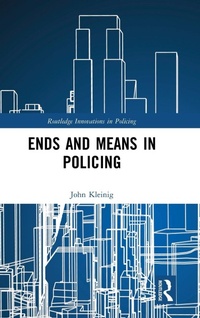
Ends and Means in Policing
1st Edition
Published on 28. February 2019
Book
Hardback
136 pages
978-0-367-02528-1 (ISBN)
Description
Policing is a highly pragmatic occupation. It is designed to achieve the important social ends of peacekeeping and public safety, and is empowered to do so using means that are ordinarily seen as problematic; that is, the use of force, deception, and invasions of privacy, along with considerable discretion. It is often suggested that the ends of policing justify the use of otherwise problematic means, but do they?
This book explores this question from a philosophical perspective. The relationship between ends and means has a long and contested history both in moral/practical reasoning and public policy. Looking at this history through the lens of policing, criminal justice philosopher John Kleinig explores the dialectic of ends and means (whether the ends justify the means, or whether the ends never justify the means) and offers a new, sharpened perspective on police ethics.
After tracing the various ways in which ends and means may be construed, the book surveys a series of increasingly concrete issues, focusing especially on those that arise in policing contexts. The competing moral demands made by ends and means culminate in considerations of noble cause corruption, dirty hands theory, lesser degradations (such as tear gas, tasers, chokeholds, and so on), and finally, those means deemed impermissible by the majority in Western culture, such as torture.
This book explores this question from a philosophical perspective. The relationship between ends and means has a long and contested history both in moral/practical reasoning and public policy. Looking at this history through the lens of policing, criminal justice philosopher John Kleinig explores the dialectic of ends and means (whether the ends justify the means, or whether the ends never justify the means) and offers a new, sharpened perspective on police ethics.
After tracing the various ways in which ends and means may be construed, the book surveys a series of increasingly concrete issues, focusing especially on those that arise in policing contexts. The competing moral demands made by ends and means culminate in considerations of noble cause corruption, dirty hands theory, lesser degradations (such as tear gas, tasers, chokeholds, and so on), and finally, those means deemed impermissible by the majority in Western culture, such as torture.
More details
Series
Language
English
Place of publication
London
United Kingdom
Publishing group
Taylor & Francis Ltd
Target group
College/higher education
Dimensions
Height: 235 mm
Width: 157 mm
Thickness: 12 mm
Weight
359 gr
ISBN-13
978-0-367-02528-1 (9780367025281)
Copyright in bibliographic data and cover images is held by Nielsen Book Services Limited or by the publishers or by their respective licensors: all rights reserved.
Schweitzer Classification
Other editions
Additional editions
John Kleinig
Ends and Means in Policing
Book
03/2021
1st Edition
Routledge
€64.60
Shipment within 15-20 days
John Kleinig
Ends and Means in Policing
E-Book
03/2019
1st Edition
Routledge
€59.49
Available for download
Person
John Kleinig is an Emeritus Professor of Philosophy in the Department of Criminal Justice, John Jay College of Criminal Justice, and in the PhD Program in Philosophy, Graduate School and University Center, City University of New York. He is also an Adjunct Research Professor at Charles Sturt University, Australia. He is the author/editor of 22 books.
Content
Acknowledgments
Introduction
Ends
The Ends of Policing
Means
Means in Policing
The Question of Justification
The Doctrine of Double Effect
Persons as Ends
Impermissible Means
Other Problematic Means
Dirty Hands and Noble Cause Corruption
Index
Introduction
Ends
The Ends of Policing
Means
Means in Policing
The Question of Justification
The Doctrine of Double Effect
Persons as Ends
Impermissible Means
Other Problematic Means
Dirty Hands and Noble Cause Corruption
Index