

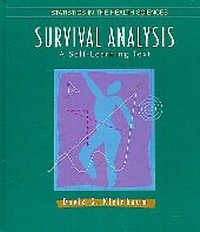
Survival Analysis
A Self-Learning Text
Published on 20. February 1997
Book
Hardback
XII, 324 pages
978-0-387-94543-9 (ISBN)
Description
A straightforward and easy-to-follow introduction to the main concepts and techniques of the subject. It is based on numerous courses given by the author to students and researchers in the health sciences and is written with such readers in mind. A "user-friendly" layout includes numerous illustrations and exercises and the book is written in such a way so as to enable readers learn directly without the assistance of a classroom instructor. Throughout, there is an emphasis on presenting each new topic backed by real examples of a survival analysis investigation, followed up with thorough analyses of real data sets. Each chapter concludes with practice exercises to help readers reinforce their understanding of the concepts covered, before going on to a more comprehensive test. Answers to both are included. Readers will enjoy David Kleinbaums style of presentation, making this an excellent introduction for all those coming to the subject for the first time.
More details
Series
Edition
1st ed. 1996. Corr. 2nd printing
Language
English
Place of publication
NY
United States
Target group
College/higher education
Professional and scholarly
Illustrations
90 illus.
Dimensions
Height: 23.5 cm
Width: 20.6 cm
Weight
800 gr
ISBN-13
978-0-387-94543-9 (9780387945439)
DOI
10.1007/978-1-4757-2555-1
Schweitzer Classification
Other editions
New editions
Book
08/2011
3rd Edition
Springer
€117.69
Shipment within 15-20 days
Book
08/2005
2nd Edition
Springer
€82.34
Article exhausted; check for reprint
Additional editions
E-Book
04/2013
1st Edition
Springer
€85.59
Available for download
Content
Introduction to Survival Analysis.- Kaplan-Meier Survival Curves and the Log-Rank Test.- The Cox Proportional Hazards Model and Its Characteristics.- Evaluating the Proportional Hazards Assumption.- The Stratified Cox Procedure.- Extension of the Cox Proportional Hazards Model for Time-Dependent Variables.- Parametric Survival Models.- Recurrent Events Survival Analysis.- Competing Risks Survival Analysis.