

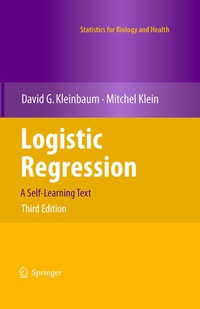
Logistic Regression
A Self-Learning Text
3rd Edition
Published on 1. July 2010
Book
Paperback/Softback
XVII, 702 pages
978-1-4939-3697-7 (ISBN)
Description
This is the third edition of this text on logistic regression methods, originally published in 1994, with its second e- tion published in 2002. As in the first two editions, each chapter contains a pres- tation of its topic in "lecture?book" format together with objectives, an outline, key formulae, practice exercises, and a test. The "lecture book" has a sequence of illust- tions, formulae, or summary statements in the left column of each page and a script (i. e. , text) in the right column. This format allows you to read the script in conjunction with the illustrations and formulae that highlight the main points, formulae, or examples being presented. This third edition has expanded the second edition by adding three new chapters and a modified computer appendix. We have also expanded our overview of mod- ing strategy guidelines in Chap. 6 to consider causal d- grams. The three new chapters are as follows: Chapter 8: Additional Modeling Strategy Issues Chapter 9: Assessing Goodness of Fit for Logistic Regression Chapter 10: Assessing Discriminatory Performance of a Binary Logistic Model: ROC Curves In adding these three chapters, we have moved Chaps. 8 through 13 from the second edition to follow the new chapters, so that these previous chapters have been ren- bered as Chaps. 11-16 in this third edition.
Reviews / Votes
From the reviews of the third edition:
"The third edition of this book continues the tradition of the authors of a two-column book that really does act as a self-learning text. The left-hand column is like a collection of PowerPoint slides, including generic-style computer output and diagrams to visualize the relationship between concepts. Each chapter contains about 10 exercises, some routine calculation and some asking for explanation of particular points. Answers are provided immediately. . The reference list includes about 40 items and has been updated to include publications up to 2008." (Alice Richardson, International Statistical Review, Vol. 79 (2), 2011)More details
Series
Edition
3rd ed. 2010
Language
English
Place of publication
New York
United States
Target group
Professional and scholarly
Illustrations
XVII, 702 p.
Dimensions
Height: 254 mm
Width: 178 mm
Thickness: 39 mm
Weight
1330 gr
ISBN-13
978-1-4939-3697-7 (9781493936977)
DOI
10.1007/978-1-4419-1742-3
Schweitzer Classification
Other editions
Additional editions
Book
07/2010
3rd Edition
Springer
€160.49
Shipment within 15-20 days
Persons
Dr. Kevin M. Sullivan is an Associate Professor of Epidemiology at Emory University's Rollins School of Public Health. He has worked in the area of epidemiology and public health for over 35 years and has over 84 publications in peer-reviewed journals, has co-authored a number of books and manuals on epidemiology and epidemiologic software, and has published chapters in several books. He is one of the developers of OpenEpi (www.OpenEpi.com ) and Epi Info (www.cdc.gov/EpiInfo) computer programs.
David G. Kleinbaum is a Professor of Epidemiology at Emory University's Rollins School of Public Health in Atlanta, GA, and an internationally recognized expert in teaching biostatistical and epidemiological concepts and methods at all levels.
Ms. Nancy Barker is a statistical consultant who formerly worked at the Centers for Disease Control and Prevention.
Content
to Logistic Regression.- Important Special Cases of the Logistic Model.- Computing the Odds Ratio in Logistic Regression.- Maximum Likelihood Techniques: An Overview.- Statistical Inferences Using Maximum Likelihood Techniques.- Modeling Strategy Guidelines.- Modeling Strategy for Assessing Interaction and Confounding.- Additional Modeling Strategy Issues.- Assessing Goodness of Fit for Logistic Regression.- Assessing Discriminatory Performance of a Binary Logistic Model: ROC Curves.- Analysis of Matched Data Using Logistic Regression.- Polytomous Logistic Regression.- Ordinal Logistic Regression.- Logistic Regression for Correlated Data: GEE.- GEE Examples.- Other Approaches for Analysis of Correlated Data.