

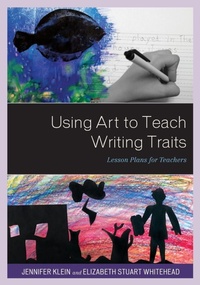
Using Art to Teach Writing Traits
Lesson Plans for Teachers
Published on 23. November 2018
Book
Paperback/Softback
202 pages
978-1-4758-3993-7 (ISBN)
Description
Our purpose for writing this book is so that children can become better communicators by expressing their thoughts, feelings and ideas. The ability to communicate is a universal goal in society. If children can better communicate in their speaking and writing, clearer more precise messages will be received, and communication around the world will be strengthened. The writing traits are a way for teachers and children to discuss and analyze written pieces, for strengths and needs, in order communicate their thoughts and expresses their ideas through writing in a way that touches their audience. Adding art into this established process will allow children to learn about the writing traits in a text-free environment before applying the traits to their own writing. Children will learn how artists communicate their thoughts, feelings and ideas, and how the traits that writers use are similar to the traits that artists use in order to better communicate, express themselves, and process the world around them. In addition, we will discuss the revision and editing process. Art is an exciting and engaging subject for students. This book will allow children to transfer their knowledge of how artists use the traits, to how writers use the traits, and then to how they can utilize the traits in their own writing, to better communicate with their audience and process the world around them.
Reviews / Votes
Using Art to Teach Writing comprehensively and creatively addresses the teaching of writing to developing and struggling young writers. This well-resourced book encourages the use of a multiplicity of modalities through art. It recognizes the power of art as a language that can be harnessed to develop skills in writing. We create "images" prior to learning to create text, so to me, this is perceptive and intelligent thinking. -- Thom Knab, K-4 Art Educator, Dodge Elementary School, NY; NAEA President Elect Once again, Klein and Whitehead are brilliant in crafting a book that provides a practical, classroom-friendly approach to teaching the specific traits of writing. Facing a blank page before writing can be a scary experience for some children. By comparison, the same children might feel very comfortable discussing a painting or other work of art. The teacher can ask, "What do you see?" After examining or creating a piece of art, children can then begin to apply a similar thought process to their writing. -- Tina Yingling, Reading Specialist, Montgomery County Public Schools, MD Using Art to Teach Writing Comprehension Strategies provides practical activities and pathways that support utilizing art as a primary source for student-centered engagement and learning. The research-based and standards aligned lessons are applicable across disciplines and support the development of essential 21-st century skills in multiple contexts, including the museum setting. -- Brittany Powell, Manager of School Programs, the Walters Art MuseumMore details
Language
English
Place of publication
United States
Publishing group
Bloomsbury Publishing Plc
Target group
Professional and scholarly
Dimensions
Height: 254 mm
Width: 178 mm
Thickness: 11 mm
Weight
395 gr
ISBN-13
978-1-4758-3993-7 (9781475839937)
Copyright in bibliographic data and cover images is held by Nielsen Book Services Limited or by the publishers or by their respective licensors: all rights reserved.
Schweitzer Classification
Other editions
Additional editions
Jennifer Klein | Elizabeth Stuart Whitehead
Using Art to Teach Writing Traits
Lesson Plans for Teachers
E-Book
11/2018
1st Edition
Rowman & Littlefield Education
€29.49
Available for download
Jennifer Klein | Elizabeth Stuart Whitehead
Using Art to Teach Writing Traits
Lesson Plans for Teachers
E-Book
11/2018
1st Edition
National Art Educators Association
€29.49
Available for download
Persons
Elizabeth Stuart Whitehead taught elementary art for nine years and was the content specialist for art, theatre, and dance for Montgomery County Public Schools in Rockville, Maryland, for seven years. Currently, she is Visual Art Supervisor for Prince George's County Public Schools in Maryland. Prince George's County is a pioneer in Arts Integration (AI) with 75+ model schools and growing.
Jennifer Klein is currently a reading specialist for Montgomery County Public Schools. Over the course of her career, she has worked as an elementary classroom teacher, gifted and talented teacher, staff developer, and teacher trainer for MCPS. Over the past several years, she has merged these passions to create after-school and summer workshops for children including the Artist/Readers' Workshop and the Artist/Writers' Workshop, and has also taught at the Rehoboth Art league in Rehoboth, Delaware.
Jennifer Klein is currently a reading specialist for Montgomery County Public Schools. Over the course of her career, she has worked as an elementary classroom teacher, gifted and talented teacher, staff developer, and teacher trainer for MCPS. Over the past several years, she has merged these passions to create after-school and summer workshops for children including the Artist/Readers' Workshop and the Artist/Writers' Workshop, and has also taught at the Rehoboth Art league in Rehoboth, Delaware.
Content
Dedication
Preface
Acknowledgements
Introduction
Chapter One: Ideas- Ideas Are All Around You!
Chapter Two: Organization- Putting the Pieces Together
Chapter Three: Word Choice- Artful Language
Chapter Four: Voice- Drawing Your Audience In
Chapter Five: Sentence Fluency- Mix it Up
Chapter Six: Conventions- Polishing Your Work
Chapter Seven: Presenting and Publishing: Sharing Your Work with Others
Bibliography
? Children's Books
? Professional Education Books
? Art References
? Websites
About the Authors
Preface
Acknowledgements
Introduction
Chapter One: Ideas- Ideas Are All Around You!
Chapter Two: Organization- Putting the Pieces Together
Chapter Three: Word Choice- Artful Language
Chapter Four: Voice- Drawing Your Audience In
Chapter Five: Sentence Fluency- Mix it Up
Chapter Six: Conventions- Polishing Your Work
Chapter Seven: Presenting and Publishing: Sharing Your Work with Others
Bibliography
? Children's Books
? Professional Education Books
? Art References
? Websites
About the Authors