

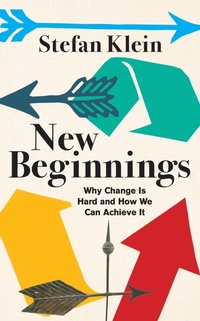
New Beginnings
Why Change Is Hard and How We Can Achieve It
Published on 12. February 2026
Book
Hardback
320 pages
978-1-917189-29-3 (ISBN)
Description
We know that we must change ourselves and the world if we want to survive. So why do we cling to old habits and false certainties instead of embracing change now?
In New Beginnings, Stefan Klein delves into the most pressing problems facing our world - from the climate crisis to the rapid development of artificial intelligence - and investigates why individuals and societies often resist necessary changes, despite knowing the risks of inaction.
Blending scientific insights with vivid storytelling, Klein unpacks the psychological and social forces that keep us stuck, and identifies what he calls the 'seven illusions about progress' that hinder our ability to adapt. Central to his analysis is the idea that transformation is not only necessary but also achievable, provided we understand the mechanisms of change and embrace a mindset that values adaptability.
New Beginnings stands out for its ability to make complex global challenges comprehensible and relatable. With his trademark clarity and optimism, Klein inspires belief that necessary change is not only possible but accessible for a sustainable future.
In New Beginnings, Stefan Klein delves into the most pressing problems facing our world - from the climate crisis to the rapid development of artificial intelligence - and investigates why individuals and societies often resist necessary changes, despite knowing the risks of inaction.
Blending scientific insights with vivid storytelling, Klein unpacks the psychological and social forces that keep us stuck, and identifies what he calls the 'seven illusions about progress' that hinder our ability to adapt. Central to his analysis is the idea that transformation is not only necessary but also achievable, provided we understand the mechanisms of change and embrace a mindset that values adaptability.
New Beginnings stands out for its ability to make complex global challenges comprehensible and relatable. With his trademark clarity and optimism, Klein inspires belief that necessary change is not only possible but accessible for a sustainable future.
Reviews / Votes
'Klein's detailed three-part exploration of human behaviour in the face of disaster - whether it is climate change, AI or the ageing global population - pairs scientific findings and historical examples to illustrate how humankind has not always acted in its own best interests ... Stefan Klein's prose is in the tradition of the best English-language nonfiction writers, such as Malcolm Gladwell, Steven Pinker, and Michael Pollan ... this accessible book sheds some light on the more confounding aspects of humanity's behaviour.' * New Books in German *More details
Language
English
Place of publication
London
United Kingdom
Dimensions
Height: 220 mm
Width: 141 mm
Thickness: 32 mm
Weight
425 gr
ISBN-13
978-1-917189-29-3 (9781917189293)
Copyright in bibliographic data and cover images is held by Nielsen Book Services Limited or by the publishers or by their respective licensors: all rights reserved.
Schweitzer Classification
Persons
Stefan Klein, born in 1965, is Germany's most successful science author and is recognised as one of Europe's most influential science writers and journalists. After studying physics and analytical philosophy in Munich, Grenoble, and Freiburg, he turned to writing because he 'wanted to inspire people for a reality that is more exciting than any crime thriller'. His books, which have been translated into more than 25 languages, include the #1 international bestseller The Science of Happiness, The Secret Pulse of Time, Leonardo's Legacy, and We Are All Stardust. He lives and works as a freelance writer in Berlin.
David Shaw works as a journalist for Germany's international broadcaster, Deutsche Welle, as well as translating from several languages, including German, Dutch, Russian, and French. He lives in Berlin.
David Shaw works as a journalist for Germany's international broadcaster, Deutsche Welle, as well as translating from several languages, including German, Dutch, Russian, and French. He lives in Berlin.