

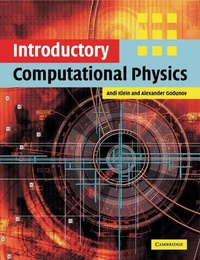
Introductory Computational Physics
Published on 10. June 2010
Book
Paperback/Softback
148 pages
978-0-521-53562-5 (ISBN)
Description
Computers are one of the most important tools available to physicists, whether for calculating and displaying results, simulating experiments, or solving complex systems of equations. Introducing students to computational physics, this textbook, first published in 2006, shows how to use computers to solve mathematical problems in physics and teaches students about choosing different numerical approaches. It also introduces students to many of the programs and packages available. The book relies solely on free software: the operating system chosen is Linux, which comes with an excellent C++ compiler, and the graphical interface is the ROOT package available for free from CERN. This broad scope textbook is suitable for undergraduates starting on computational physics courses. It includes exercises and many examples of programs. Online resources at www.cambridge.org/0521828627 feature additional reference information, solutions, and updates on new techniques, software and hardware used in physics.
More details
Language
English
Place of publication
Cambridge
United Kingdom
Target group
College/higher education
Professional and scholarly
Product notice
Paperback (trade)
Illustrations
32 Halftones, unspecified; 9 Line drawings, unspecified
Dimensions
Height: 246 mm
Width: 189 mm
Thickness: 8 mm
Weight
301 gr
ISBN-13
978-0-521-53562-5 (9780521535625)
Copyright in bibliographic data and cover images is held by Nielsen Book Services Limited or by the publishers or by their respective licensors: all rights reserved.
Schweitzer Classification
Other editions
Additional editions
Andi Klein | Alexander Godunov
Introductory Computational Physics
E-Book
04/2006
1st Edition
Cambridge University Press
€26.49
Available for download
Persons
Andi Klein is a technical staff member at Los Alamos National Laboratory, New Mexico. Alexander Godunov is Research Assistant Professor at the Department of Physics, Old Dominion University, Virginia.
Content
1. Introduction; 2. Basics; 3. Short introduction to Linux; 4. Interpolation I; 5. Interpolation II; 6. Taking derivatives; 7. Numerical integration; 8. Solution of nonlinear equations; 9. Differential equations; 10. Matrices; 11. Random processes and Monte Carlo simulation; A. The ROOT system; B. Free scientific libraries; C. FORTRAN and C++; D. Program listings.