

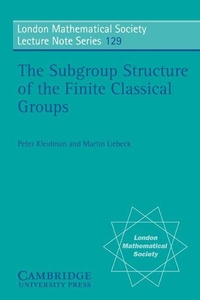
The Subgroup Structure of the Finite Classical Groups
Published on 26. April 1990
Book
Paperback/Softback
316 pages
978-0-521-35949-8 (ISBN)
Description
With the classification of the finite simple groups complete, much work has gone into the study of maximal subgroups of almost simple groups. In this volume the authors investigate the maximal subgroups of the finite classical groups and present research into these groups as well as proving many new results. In particular, the authors develop a unified treatment of the theory of the 'geometric subgroups' of the classical groups, introduced by Aschbacher, and they answer the questions of maximality and conjugacy and obtain the precise shapes of these groups. Both authors are experts in the field and the book will be of considerable value not only to group theorists, but also to combinatorialists and geometers interested in these techniques and results. Graduate students will find it a very readable introduction to the topic and it will bring them to the very forefront of research in group theory.
More details
Series
Language
English
Place of publication
Cambridge
United Kingdom
Target group
Professional and scholarly
Product notice
Paperback (trade)
Illustrations
Worked examples or Exercises
Dimensions
Height: 229 mm
Width: 152 mm
Thickness: 19 mm
Weight
515 gr
ISBN-13
978-0-521-35949-8 (9780521359498)
Copyright in bibliographic data and cover images is held by Nielsen Book Services Limited or by the publishers or by their respective licensors: all rights reserved.
Schweitzer Classification
Other editions
Additional editions
Peter B. Kleidman | Martin W. Liebeck
The Subgroup Structure of the Finite Classical Groups
E-Book
01/2011
1st Edition
Cambridge University Press
€88.99
Available for download
Content
1. Motivation and setting for the results; 2. Basic properties of the classical groups; 3. The statement of the main theorem; 4. The structure and conjugacy of the members of C; 5. Properties of the finite simple groups; 6. Non-maximal subgroups in C: the examples; 7. Determining the maximality of members of C, Part I; 8. Determining the maximality of members of C, Part II.