

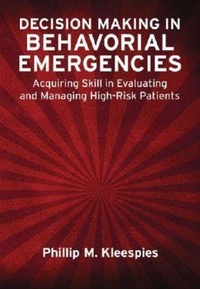
Decision Making in Behavioral Emergencies
Acquiring Skill in Evaluating and Managing High-Risk Patients
Will be published approx. on 13. January 2014
Book
Hardback
210 pages
978-1-4338-1664-2 (ISBN)
Description
Nearly every clinician will eventually have to face a amp ldquo behavioral emergency amp rdquo -a situation in which a client is at risk of suicide, violence, or becoming the victim of violence. Yet few clinicians have been trained to deal with the life-or-death judgments that are required in the stress of these moments.
This practical, comprehensive book is designed to help practitioners make good decisions under difficult conditions. It straightforwardly addresses such vital topics as how to assess efficiently, how to think clearly under pressure, and how to prepare effectively for emergencies.
This practical, comprehensive book is designed to help practitioners make good decisions under difficult conditions. It straightforwardly addresses such vital topics as how to assess efficiently, how to think clearly under pressure, and how to prepare effectively for emergencies.
More details
Language
English
Place of publication
Washington DC
United States
Target group
Professional and scholarly
Product notice
sewn/stitched
Paper over boards
Dimensions
Height: 244 mm
Width: 168 mm
Thickness: 15 mm
Weight
408 gr
ISBN-13
978-1-4338-1664-2 (9781433816642)
Copyright in bibliographic data and cover images is held by Nielsen Book Services Limited or by the publishers or by their respective licensors: all rights reserved.
Schweitzer Classification
Person
Phillip M. Kleespies, PhD, was awarded his doctoral degree in clinical psychology from Clark University in 97 . He is a clinical psychologist in the Department of Veterans Affairs Boston Healthcare System and an assistant clinical professor of psychiatry at Boston University School of Medicine.
Dr. Kleespies has more than 4 years of experience in working in emergency department, urgent care clinic, and inpatient psychiatry settings with patients who are at risk of such behavioral emergencies as suicidal behavior, violence, and interpersonal victimization. In 2 3, he was recognized with the Outstanding Clinician Award presented by the VA Section of APA Division 8 (Psychologists in Public Service).
Dr. Kleespies has also been an active supervisor and teacher to psychology interns and psychology postdoctoral fellows with an interest in evaluating and managing patients at risk to self and others. His research interests have included the development of a database for the study of self-injurious and suicidal behavior in veterans and the impact of patient suicide and suicidal behavior on the treating clinicians.
Dr. Kleespies has authored and coauthored many publications, and he has made numerous presentations on behavioral emergencies and related topics. He is a contributing author and the editor of the books Emergencies in Mental Health Practice: Evaluation and Management ( 998) and Behavioral Emergencies: An Evidence-Based Resource for Evaluating and Managing Risk of Suicide, Violence, and Victimization (2 9). In addition, he is the author of the book Life and Death Decisions: Psychological and Ethical Considerations in End-of-Life Care (2 4).
He has served as a member of the VA Boston Ethics Case Consultation Team, the VA Boston Palliative Care Consult Team, and the VA Boston Violence Threat Assessment Committee.
Dr. Kleespies is a diplomate in clinical psychology of the American Board of Professional Psychology and an APA fellow. He was the founding president of the Section on Clinical Emergencies and Crises, Section VII of APA Division 2 (Society of Clinical Psychology), and he remains involved with the section as advisor to the Executive Board.
Dr. Kleespies has more than 4 years of experience in working in emergency department, urgent care clinic, and inpatient psychiatry settings with patients who are at risk of such behavioral emergencies as suicidal behavior, violence, and interpersonal victimization. In 2 3, he was recognized with the Outstanding Clinician Award presented by the VA Section of APA Division 8 (Psychologists in Public Service).
Dr. Kleespies has also been an active supervisor and teacher to psychology interns and psychology postdoctoral fellows with an interest in evaluating and managing patients at risk to self and others. His research interests have included the development of a database for the study of self-injurious and suicidal behavior in veterans and the impact of patient suicide and suicidal behavior on the treating clinicians.
Dr. Kleespies has authored and coauthored many publications, and he has made numerous presentations on behavioral emergencies and related topics. He is a contributing author and the editor of the books Emergencies in Mental Health Practice: Evaluation and Management ( 998) and Behavioral Emergencies: An Evidence-Based Resource for Evaluating and Managing Risk of Suicide, Violence, and Victimization (2 9). In addition, he is the author of the book Life and Death Decisions: Psychological and Ethical Considerations in End-of-Life Care (2 4).
He has served as a member of the VA Boston Ethics Case Consultation Team, the VA Boston Palliative Care Consult Team, and the VA Boston Violence Threat Assessment Committee.
Dr. Kleespies is a diplomate in clinical psychology of the American Board of Professional Psychology and an APA fellow. He was the founding president of the Section on Clinical Emergencies and Crises, Section VII of APA Division 2 (Society of Clinical Psychology), and he remains involved with the section as advisor to the Executive Board.
Content
Preface
Acknowledgments
Introduction
Evaluating and Managing Behavioral Emergencies and Crises: An Overview
Decision Making Under Stress: Theoretical and Empirical Bases
Training to Reduce Stress in Dealing With Behavioral Emergencies
Mental Practice for Decision Making During Behavioral Emergencies
The Use of Decision-Support Tools in Behavioral Emergencies
Training for Decision Making With Experience Near or Actual Behavioral Emergencies
The Stress of Legal and Ethical Issues in High-Risk Cases
Coping With the Emotional Aftermath of Negative Events
Afterword
References
Index
About the Author
Acknowledgments
Introduction
Evaluating and Managing Behavioral Emergencies and Crises: An Overview
Decision Making Under Stress: Theoretical and Empirical Bases
Training to Reduce Stress in Dealing With Behavioral Emergencies
Mental Practice for Decision Making During Behavioral Emergencies
The Use of Decision-Support Tools in Behavioral Emergencies
Training for Decision Making With Experience Near or Actual Behavioral Emergencies
The Stress of Legal and Ethical Issues in High-Risk Cases
Coping With the Emotional Aftermath of Negative Events
Afterword
References
Index
About the Author