

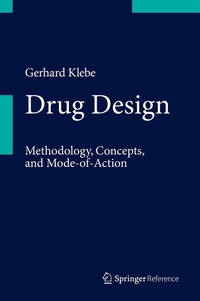
Drug Design
Description
Reviews / Votes
Aus den Rezensionen:
"... stellt eine sehr gute Informationsquelle für einen Diplomanden oder Doktoranden der pharmazeutischen Chemie dar, der in diesem Bereich arbeitet und am Beginn seiner wissenschaftlichen Karriere steht ... für jeden Lehrenden in der pharmazeutischen Chemie geeignet, um die Vorlesung um interessante Aspekte zu ergänzen." (Dr. Stefan Fischer, in: MMP Medizinische Monatsschrift für Pharmazeuten, Heft 6, 2014)
More details
Other editions
Additional editions
Person
Content
Part I Fundamentalsin Drug Research.- 1. Drug Research Yesterday, Today and Tomorrow.- 2. The Role of Serendipityin Drug Research.- 3. Classical Drug Research.- 4. Protein-Ligand Interactionsas the Basis for Drug Action.- 5. Optical Activity and Biological Effects.- Part II Discovery and Optimizationof Lead Compounds.- 6. Screeningfor Lead Structures.- 7. Screening Technologies for LeadDiscovery.- 8. Optimizationof Lead Structures.- 9. Designingprodrugs.- 10. Peptidomimetics.- Part III Experimental and Theoretical Methods.- 11. Combinatorics: Chemistry With Big Numbers.- 12. Gene Technology in drug research.- 13. Experimental Methods of Structure Determination.- 14. The Spatial Structure of Biomolecules.- 15. Molecular Modelling.- 16. Conformational Analysis.- Part IV Structure-Activity Relationships and Design Approaches.- 17.Pharmacophore Hypothesis and Molecular Comparisons.- 18. Quantitative Structure-ActivityRelationships.- 19. From in vitro to in vivo:Optimization of ADME-Tox Properties.- 20. ProteinModeling and Structure-BasedDrug Design.- 21. ACase Study: Structure-Based Inhibtor Design for tRNA-Guanine Transglycosylase.- Part V. Drugs and drug action: Successes of stucture-based design.- 22. Howdrugs act: Concepts for therapy.- 23. Inhibitors of hydrolases With an acyl-enzymeintermediate.- 24. Asparticprotease inhibitors.- 25. Inhibitorsof hydrolysing metalloenzymes.- 26. Inhibitorsof transferases.- 27. Inhibitors ofoxidoreductases.- 28. Agonists and antagonistsof nuclear receptors.- 29. Agonists and antagonists of membrane-bound.- 30. Ligands forchannels, pores and transporters.- 31. Ligands for surfacereceptors.- 32. Biologicals: Peptides, proteins, nucleotidesand macrolides as drugs.