

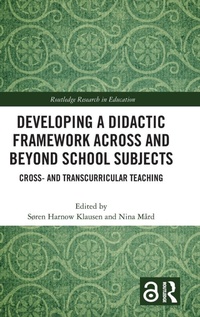
Developing a Didactic Framework Across and Beyond School Subjects
Cross- and Transcurricular Teaching
1st Edition
Published on 22. December 2023
Book
Hardback
252 pages
978-1-032-43320-2 (ISBN)
Description
Centered around a contemporary conception of Bildung, this book effectively demonstrates how the aims of cross- and transcurricular teaching can be reconciled, resulting in a didactic framework for teaching and learning in secondary schools that can be applied internationally.
Chapters present a nuanced and unified approach to fusing theory and practice by offering accounts of some of the most promising teaching methods from leading scholars in the field of curriculum research. These methods include dialogic teaching or movement integration, transversal competences like digital or entrepreneurial thinking, and topics that call for crosscurricular approaches, like sustainability or citizenship. Addressing diverse worries and criticisms of crosscurricular teaching, the book includes international viewpoints and trends such as sustainability, citizenship, and student motivation to present a comprehensive and systematic scholarly treatment of crosscurricular didactics within the classroom. It further addresses important challenges that have been widely ignored, like how to evaluate crosscurricular work.
Ultimately, this volume makes a highly novel contribution to the field of crosscurricular didactics, and will be of interest to researchers, scholars, and academics in the fields of secondary education teaching and learning, educational science, and curriculum design. Those interested more broadly in the theory of education will also find the volume of use.
The Open Access version of this book, available at www.taylorfrancis.com, has been made available under a Creative Commons Attribution- Non Commercial-No Derivatives (CC-BY-NC-ND) 4.0 license.
Chapters present a nuanced and unified approach to fusing theory and practice by offering accounts of some of the most promising teaching methods from leading scholars in the field of curriculum research. These methods include dialogic teaching or movement integration, transversal competences like digital or entrepreneurial thinking, and topics that call for crosscurricular approaches, like sustainability or citizenship. Addressing diverse worries and criticisms of crosscurricular teaching, the book includes international viewpoints and trends such as sustainability, citizenship, and student motivation to present a comprehensive and systematic scholarly treatment of crosscurricular didactics within the classroom. It further addresses important challenges that have been widely ignored, like how to evaluate crosscurricular work.
Ultimately, this volume makes a highly novel contribution to the field of crosscurricular didactics, and will be of interest to researchers, scholars, and academics in the fields of secondary education teaching and learning, educational science, and curriculum design. Those interested more broadly in the theory of education will also find the volume of use.
The Open Access version of this book, available at www.taylorfrancis.com, has been made available under a Creative Commons Attribution- Non Commercial-No Derivatives (CC-BY-NC-ND) 4.0 license.
More details
Series
Language
English
Place of publication
London
United Kingdom
Publishing group
Taylor & Francis Ltd
Target group
College/higher education
Postgraduate
Illustrations
9 s/w Abbildungen, 2 s/w Photographien bzw. Rasterbilder, 7 s/w Zeichnungen, 4 s/w Tabellen
4 Tables, black and white; 7 Line drawings, black and white; 2 Halftones, black and white; 9 Illustrations, black and white
Dimensions
Height: 240 mm
Width: 161 mm
Thickness: 19 mm
Weight
573 gr
ISBN-13
978-1-032-43320-2 (9781032433202)
Copyright in bibliographic data and cover images is held by Nielsen Book Services Limited or by the publishers or by their respective licensors: all rights reserved.
Schweitzer Classification
Other editions
Additional editions
Soren Harnow Klausen | Nina Mard
Developing a Didactic Framework Across and Beyond School Subjects
Cross- and Transcurricular Teaching
Book
05/2025
1st Edition
Routledge
€65.50
Shipment within 10-20 days
Soren Harnow Klausen | Nina Mard
Developing a Didactic Framework Across and Beyond School Subjects
Cross- and Transcurricular Teaching
E-Book
12/2023
1st Edition
Taylor & Francis
€0.00
Available for download
Soren Harnow Klausen | Nina Mard
Developing a Didactic Framework Across and Beyond School Subjects
Cross- and Transcurricular Teaching
E-Book
12/2023
1st Edition
Taylor & Francis
€0.00
Available for download
Persons
Nina Mard is Lecturer of Education, Faculty of Education and Welfare Studies, Abo Akademi University, Finland.
Soren Harnow Klausen is Professor of Philosophy, Department of Media, Design, Education and Cognition, University of Southern Denmark, and Guest Professor in Crosscurricular Education, Abo Akademi University, Finland.
Soren Harnow Klausen is Professor of Philosophy, Department of Media, Design, Education and Cognition, University of Southern Denmark, and Guest Professor in Crosscurricular Education, Abo Akademi University, Finland.
Content
1. Introduction
PART 1. General theory
2. Speaking and thinking about cross-curricular teaching: Terms, concepts and conceptions
3. Rationale and aims of crosscurricular teaching and learning: For life, knowledge, and work
4. Crosscurricular work and Bildung - Empowering the students
5. Crosscurricular teacher collaboration actualizing teacher professionalism - revising a didactic model
PART 2. Crosscurricular teaching, thinking and competences
6. Dialogic teaching
7. Integrating movement and physical education into subject teaching: Learning by moving
8. Fostering wellbeing competence through crosscurricular teaching: Wellbeing and skills for life
9. Mathematics beyond and across the curriculum
10. A rhizomatic approach to arts integration in literacies and literary education: Embracing unpredictability
11. Inspiring self-reflective dialogues through aesthetic learning processes: Learning by drawing
PART 3. Contemporary themes calling for crosscurricular approaches
12. Analyzing domains of learning for crosscurricular teaching - Educational crafts in focus
13. Sustainability teaching: Towards an empirically grounded model
14. Climate change as a socio-scientific issue in upper secondary education: Addressing wicked problems through crosscurricular approaches
15. Education for democracy and democratic citizenship
16. Teaching for entrepreneurial Bildung in school
17. Language and literacy across and beyond the curriculum
18. Computational thinking beyond computer science
19. Conclusion
PART 1. General theory
2. Speaking and thinking about cross-curricular teaching: Terms, concepts and conceptions
3. Rationale and aims of crosscurricular teaching and learning: For life, knowledge, and work
4. Crosscurricular work and Bildung - Empowering the students
5. Crosscurricular teacher collaboration actualizing teacher professionalism - revising a didactic model
PART 2. Crosscurricular teaching, thinking and competences
6. Dialogic teaching
7. Integrating movement and physical education into subject teaching: Learning by moving
8. Fostering wellbeing competence through crosscurricular teaching: Wellbeing and skills for life
9. Mathematics beyond and across the curriculum
10. A rhizomatic approach to arts integration in literacies and literary education: Embracing unpredictability
11. Inspiring self-reflective dialogues through aesthetic learning processes: Learning by drawing
PART 3. Contemporary themes calling for crosscurricular approaches
12. Analyzing domains of learning for crosscurricular teaching - Educational crafts in focus
13. Sustainability teaching: Towards an empirically grounded model
14. Climate change as a socio-scientific issue in upper secondary education: Addressing wicked problems through crosscurricular approaches
15. Education for democracy and democratic citizenship
16. Teaching for entrepreneurial Bildung in school
17. Language and literacy across and beyond the curriculum
18. Computational thinking beyond computer science
19. Conclusion