

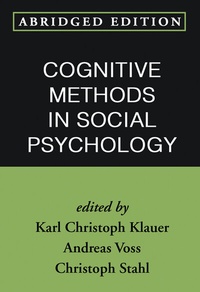
Cognitive Methods in Social Psychology
1st Edition
Published on 9. November 2012
Book
Paperback/Softback
415 pages
978-1-4625-0913-3 (ISBN)
Description
Researchers are increasingly applying cognitive methods to investigate social psychological phenomena. This book provides a comprehensive introduction to widely used social cognitive methods and offers practical, nuts-and-bolts guidance for implementing them. Leading authorities present attentional paradigms, priming paradigms, and response interference tasks; psychobiological approaches, such as neuroimaging; applications of mathematical models; and other methods. Detailed procedural information helps researchers and students take their first steps in using these state-of-the-art tools. Each chapter is illustrated with recent research examples and includes helpful recommendations for further reading.
Note: The hardcover edition of this book contained a chapter titled Priming as Proxy: Understanding the Subjectivity of Social Life, by D. A. Stapel. This chapter has been retracted by joint decision of the publisher and the book's editors.
Note: The hardcover edition of this book contained a chapter titled Priming as Proxy: Understanding the Subjectivity of Social Life, by D. A. Stapel. This chapter has been retracted by joint decision of the publisher and the book's editors.
Reviews / Votes
"A detailed and tightly-edited book. ... Simply put, members of the discipline who ignore this intriguing book, its insights on theory development, and its methodological 'how to' focus, do so at their intellectual peril." - Dana S. Dunn and Brittany Beard, Journal of Social and Clinical Psychology ,Vol. 30, No. 10, December 2011"To understand the cognitive processes involved in social phenomena, social psychologists routinely borrow methods from cognitive psychology. This book offers an excellent overview of these methods and ensures that readers can make good use of them. Each chapter covers one methodological approach, from its theoretical rationale and social psychological applications to the nuts and bolts of its implementation in the laboratory. The book is suitable for graduate-level research methods classes in psychology and is highly recommended for seasoned researchers as well." - Norbert Schwarz, Charles Horton Cooley Collegiate Professor of Psychology, University of Michigan, USA"Social psychologists have been waiting for a book like this for years. Finally, in one place, a practical how-to guide to the most widely used methods for conducting social-cognitive research. The contributors do a wonderful job of explaining both the best uses for these measures and the details of implementing them effectively. Every social psychological researcher will want to own this book as a reference." - Jeffrey Sherman, Department of Psychology, University of California, Davis, USA "A detailed and tightly-edited book. ... Simply put, members of the discipline who ignore this intriguing book, its insights on theory development, and its methodological 'how to' focus, do so at their intellectual peril." - Dana S. Dunn and Brittany Beard, Journal of Social and Clinical Psychology ,Vol. 30, No. 10, December 2011
"Social psychologists have been waiting for a book like this for years. Finally, in one place, a practical how-to guide to the most widely used methods for conducting social-cognitive research. The contributors do a wonderful job of explaining both the best uses for these measures and the details of implementing them effectively. Every social psychological researcher will want to own this book as a reference." - Jeffrey Sherman, Department of Psychology, University of California, Davis, USA
More details
Language
English
Place of publication
New York
United States
Publishing group
Guilford Publications
Target group
Professional and scholarly
Professional Practice & Development
Dimensions
Height: 234 mm
Width: 156 mm
Weight
700 gr
ISBN-13
978-1-4625-0913-3 (9781462509133)
Copyright in bibliographic data and cover images is held by Nielsen Book Services Limited or by the publishers or by their respective licensors: all rights reserved.
Schweitzer Classification
Other editions
Additional editions
Karl Christoph Klauer | Andreas Voss | Christoph Stahl
Cognitive Methods in Social Psychology
Book
06/2011
1st Edition
Guilford Publications
€88.19
Article exhausted; check different version
Persons
Karl Christoph Klauer, PhD, is Professor at the Institute of Psychology at the University of Freiburg in Germany. His scientific interests comprise mathematical psychology, social cognition, and general psychology. Dr. Klauer has received numerous scientific awards for his work, among them the Gottfried Wilhelm Leibniz Prize, which is the most renowned scientific prize awarded to scientists in Germany. Andreas Voss, PhD, is Full Professor for Research Methods in the Department of Psychology at the University of Heidelberg in Germany. From the beginning of his academic career, Dr. Voss has focused on quantitative models of decision making in his research. Specifically, his work centers on the analysis of cognitive processes in binary decisions with stochastic diffusion models. Christoph Stahl, PhD, is Full Professor for Research Methods and Experimental Psychology at the University of Cologne in Germany. Dr. Stahl's research involves different aspects of cognitive psychology, such as episodic memory, evaluative conditioning, and reasoning; his interests also include multinomial processing tree models.
Content
Introduction: Cognitive Methods in Social Psychology: Inferring Latent Processes, Andreas Voss, Christoph Stahl, and Karl Christoph Klauer
1. The Assessment of Human Attention, Elaine Fox, Nazanin Derakshan, and Helen Standage
2. The Sequential Priming Paradigm: A Primer, Adriaan Spruyt, Anne Gast, and Agnes Moors
3. Response Interference Tasks as Indirect Measures of Automatic Associations, Bertram Gawronski, Roland Deutsch, and Rainer Banse
4. Evaluative Conditioning: Methodological Considerations, Jan De Houwer
5. Working Memory Capacity in Social Psychology, Brandon J. Schmeichel and Wilhelm Hofmann
6. Psycholinguistic Methods in Social Psychology, Klaus Fiedler, Malte Friese, and Michaela Waenke
7. Metacognition: Methods to Assess Primary versus Secondary Cognition, Derek D. Rucker, Pablo Brinol, and Richard E. Petty
8. Peripheral Psychophysiological Methods, Ursula Hess
9. Event-Related-Potential Methods in Social Cognition, David M. Amodio and Bruce D. Bartholow
10. Neuroimaging Methods in Social Cognition, Susanne Quadflieg and C. Neil Macrae
11. Multinomial Models and Diffusion Models, Karl Christoph Klauer, Christoph Stahl, and Andreas Voss
12. Connectionist Simulation as a Tool for Understanding Social Cognition and Neuroscience Frank Van Overwalle
1. The Assessment of Human Attention, Elaine Fox, Nazanin Derakshan, and Helen Standage
2. The Sequential Priming Paradigm: A Primer, Adriaan Spruyt, Anne Gast, and Agnes Moors
3. Response Interference Tasks as Indirect Measures of Automatic Associations, Bertram Gawronski, Roland Deutsch, and Rainer Banse
4. Evaluative Conditioning: Methodological Considerations, Jan De Houwer
5. Working Memory Capacity in Social Psychology, Brandon J. Schmeichel and Wilhelm Hofmann
6. Psycholinguistic Methods in Social Psychology, Klaus Fiedler, Malte Friese, and Michaela Waenke
7. Metacognition: Methods to Assess Primary versus Secondary Cognition, Derek D. Rucker, Pablo Brinol, and Richard E. Petty
8. Peripheral Psychophysiological Methods, Ursula Hess
9. Event-Related-Potential Methods in Social Cognition, David M. Amodio and Bruce D. Bartholow
10. Neuroimaging Methods in Social Cognition, Susanne Quadflieg and C. Neil Macrae
11. Multinomial Models and Diffusion Models, Karl Christoph Klauer, Christoph Stahl, and Andreas Voss
12. Connectionist Simulation as a Tool for Understanding Social Cognition and Neuroscience Frank Van Overwalle