

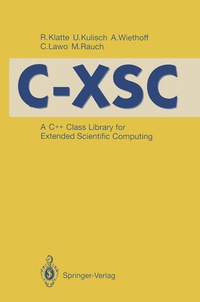
C-XSC
A C++ Class Library for Extended Scientific Computing
Published on 23. April 1993
Book
Paperback/Softback
XV, 269 pages
978-3-540-56328-0 (ISBN)
Description
C-XSC is a tool for the development of numerical algorithms delivering highly accurate and automatically verified results. It provides a large number of predefined numerical data types and operators. These types are implemented as C++ classes. Thus, C-XSC allows high-level programming of numerical applications in C and C++. The most important features of C-XSC are: real, complex, interval, and complex interval arithmetic; dynamic vectors and matrices; subarrays of vectors and matrices; dotprecision data types, predefined arithmetic operators with maximum accuracy; standard functions of high accuracy; multiple precision arithmetic and standard functions; rounding control for I/O data; error handling, and library of problem solving routines with automatic result verification. Thus, C-XSC makes the computer more powerful concerning the arithmetic. C-XSC is immediately usable by C programmers, easy to learn, user-extendable, and may also be combined with other tools. The book can be used as a textbook and as a reference manual. It consists of an introduction to advanced computer arithmetic, a chapter describing the programming languages C and C++, the major chapter "C-XSC Reference", sample programs, and indices.
More details
Edition
Softcover reprint of the original 1st ed. 1993
Language
English
Place of publication
Berlin
Germany
Publishing group
Springer Berlin
Target group
Professional and scholarly
Research
Illustrations
1 s/w Abbildung
XV, 269 p. 1 illus.
Dimensions
Height: 235 mm
Width: 155 mm
Thickness: 16 mm
Weight
441 gr
ISBN-13
978-3-540-56328-0 (9783540563280)
DOI
10.1007/978-3-642-58058-1
Schweitzer Classification
Other editions
Additional editions
Rudi Klatte | Ulrich Kulisch | Andreas Wiethoff
C-XSC
A C++ Class Library for Extended Scientific Computing
E-Book
12/2012
Springer
€96.29
Available for download
Persons
Content
1 Introduction.- 1.1 Typography.- 1.2 C-XSC: A Class Library in the Programming Language C++.- 1.3 C-XSC: A Programming Environment for Scientific Computing with Result Verification.- 1.4 Survey of C-XSC.- 2 The Programming Languages C and C++.- 2.1 A Short Introduction to C.- 2.2 Additional Features in C++.- 3 C-XSC Reference.- 3.1 Constants, Data Types, and Variables.- 3.2 Expressions.- 3.3 Statements.- 3.4 Error Handling.- 3.5 Pitfalls for Programming with C - XSC.- A Syntax Diagrams.- A.1 Data Types.- A.2 Management of Vectors and Matrices.- A.3 Definition of Variables.- A.4 Expressions.- A.5 Logical Expressions.- A.6 Type Castings.- A.7 Assignments.- A.8 Arithmetic Standard Functions.- A.9 Other Functions.- A.10 Input and Output.- A.11 Extension of a Syntax Diagram of C++.- B The Structure of the C - XSC Package.- B.1 Header Files.- B.2 Module Libraries.- C Error List.- D Sample Programs.- D.1 Rounding Control of Arithmetic Operations.- D.2 Rounding Control of Input and Output.- D.3 Scalar Product.- D.4 Transpose of a Matrix.- D.5 Trace of a Product Matrix.- D.6 Inverse of a Matrix.- D.7 Multiple-Precision Arithmetic.- D.8 Interval Newton Method.- D.9 Runge-Kutta Method.- D.10 Complex Polynomial Arithmetic.- D.11 Automatic Differentiation.- E Scientific Computation with Verified Results.- E.1 Evaluation of Polynomials.- E.2 Matrix Inversion.- E.3 Linear Systems of Equations.- E.4 Eigenvalues of Symmetric Matrices.- E.5 Fast Fourier Transform.- E.6 Zeros of a Nonlinear Equation.- E.7 System of Nonlinear Equations.- E.8 Ordinary Differential Equations.