

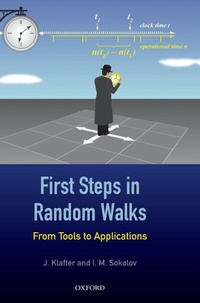
First Steps in Random Walks
From Tools to Applications
Published on 18. August 2011
Book
Hardback
160 pages
978-0-19-923486-8 (ISBN)
Description
The name "random walk" for a problem of a displacement of a point in a sequence of independent random steps was coined by Karl Pearson in 1905 in a question posed to readers of "Nature". The same year, a similar problem was formulated by Albert Einstein in one of his Annus Mirabilis works. Even earlier such a problem was posed by Louis Bachelier in his thesis devoted to the theory of financial speculations in 1900. Nowadays the theory of random walks has proved useful in physics and chemistry (diffusion, reactions, mixing in flows), economics, biology (from animal spread to motion of subcellular structures) and in many other disciplines. The random walk approach serves not only as a model of simple diffusion but of many complex sub- and super-diffusive transport processes as well. This book discusses the main variants of random walks and gives the most important mathematical tools for their theoretical description.
Reviews / Votes
Most statistical physics books treat Brownian motion, but do not introduce the student to the many examples of anomalous diffusion. This is the void the Klafter-Sokolov book fills, to bring the student into contact with modern work on random walks with a unified approach. The power here is that straightforward mathematics can be employed to tackle a rich selection of problems in anomalous diffusion. One does not need to introduce many different techniques, but to successively generalize one method and apply it to topics in physics, chemistry, and biology. * Michael Shlesinger, Office of Naval Research, USA * Klafter and Sokolov give us a systematic introduction to the mathematics of random walks, ranging from simple one-dimensional walks through Levy flights to walks on percolation structures and fractals. "First Steps " should be required reading for physicists, theoretical chemists and biologists, and applied mathematicians interested in stochastic processes. * Robert C. Hilborn, The University of Texas at Dallas, USA *More details
Language
English
Place of publication
Oxford
United Kingdom
Target group
College/higher education
Undergraduate and graduate students in physics and chemistry and lecturers in the same disciplines; postgraduate students in the same disciplines and in biology; scientific workers entering a field where random walk models are used.
Illustrations
38 line drawings
Dimensions
Height: 250 mm
Width: 175 mm
Thickness: 14 mm
Weight
470 gr
ISBN-13
978-0-19-923486-8 (9780199234868)
Copyright in bibliographic data and cover images is held by Nielsen Book Services Limited or by the publishers or by their respective licensors: all rights reserved.
Schweitzer Classification
Other editions
Additional editions
Book
11/2015
Oxford University Press
€56.31
Shipment within 15-20 days
J. Klafter | I. M. Sokolov
First Steps in Random Walks: From Tools to Applications
From Tools to Applications
E-Book
08/2011
1st Edition
OUP Oxford
€107.29
Available for download
Persons
Professor Klafter is a Fellow of the American Physical Society, and has won the Alexander von Humboldt Foundation Prize, the Weizmann Prize for Sciences, the Rothschild Prize in Chemistry, and the Israel Chemical Society Prize. He also holds an honorary doctorate from Wroclaw University of Technology in Poland. He has been the President of Tel Aviv University since 2009.
Professor Klafter has published close to 400 scientific articles and edited 18 books. He is a member of the editorial boards of six scientific journals, and has been a member of the scientific committee of dozens of conferences.
Professsor Sokolov has taught at the P.N. Lebedev Physical Institute of the Academy of Sciences of the USSR, the University of Bayreth (Germany), the University of Freiburg (Germany). Professor Sokolov currently holds the Chair for Statistical Physics and Nonlinear Dynamics at the Institute of Physics at Humboldt University in Berlin. He is the author of more than 200 publications in statistical physics as well as physical chemistry of condensed and soft matter, especially problems regarding disordered systems and polymers.
Professor Klafter has published close to 400 scientific articles and edited 18 books. He is a member of the editorial boards of six scientific journals, and has been a member of the scientific committee of dozens of conferences.
Professsor Sokolov has taught at the P.N. Lebedev Physical Institute of the Academy of Sciences of the USSR, the University of Bayreth (Germany), the University of Freiburg (Germany). Professor Sokolov currently holds the Chair for Statistical Physics and Nonlinear Dynamics at the Institute of Physics at Humboldt University in Berlin. He is the author of more than 200 publications in statistical physics as well as physical chemistry of condensed and soft matter, especially problems regarding disordered systems and polymers.
Content
1. Characteristic Functions ; 2. Generating Functions and Applications ; 3. Continuous Time Random Walks ; 4. CTRW and Aging Phenomena ; 5. Master Equations ; 6. Fractional Diffusion and Fokker-Planck Equations for Subdiffusion ; 7. Levy Flights ; 8. Coupled CTRW and Levy Walks ; 9. Simple Reactions: A+B->B ; 10. Random Walks on Percolation Structures