

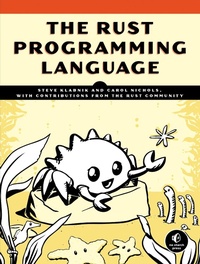
The Rust Programming Language
Will be published approx. on 26. June 2018
Book
Paperback/Softback
552 pages
978-1-59327-828-1 (ISBN)
Description
The Rust Programming Language is the official, definitive guide to Rust, a hugely popular, community-supported programming language. The reader will learn all about Rust's ownership rules, which lie at the heart of Rust's reliability and crash-resistant compiling. The Rust Programming Language covers everything from basic concepts like variable bindings, control flow, functions, and error handling, to more advanced topics, such as crates, generics, concurrency, and the nitty gritty of Rust's type system.
More details
Language
English
Place of publication
San Francisco
United States
Dimensions
Height: 235 mm
Width: 176 mm
ISBN-13
978-1-59327-828-1 (9781593278281)
Copyright in bibliographic data and cover images is held by Nielsen Book Services Limited or by the publishers or by their respective licensors: all rights reserved.
Schweitzer Classification
Other editions
New editions
Carol Nichols | Chris Krycho | Steve Klabnik
The Rust Programming Language, 3rd Edition
Book
03/2026
No Starch Press
€56.00
Available immediately
Book
02/2023
2nd Edition
No Starch Press
€47.00
Available immediately
Persons
Steve Klabnik works at Mozilla, is on the core team of Rust, and leads the documentation team. Klabnik is a frequent speaker at conferences and is a prolific open source contributor, previously working on projects such as Ruby and Ruby on Rails.
Carol Nichols is a member of the Rust Tools and Community Teams. She's a co-founder of Integer 32, LLC, the world's first Rust-focused software consultancy. She also organizes the Rust Belt Rust Conference.
Carol Nichols is a member of the Rust Tools and Community Teams. She's a co-founder of Integer 32, LLC, the world's first Rust-focused software consultancy. She also organizes the Rust Belt Rust Conference.
Content
Introduction
Chapter 1: Getting Started
Chapter 2: A Quick Tutorial---Guessing Game
Chapter 3: Common Programming Concepts
Chapter 4: Understanding Ownership
Chapter 5: Structs
Chapter 6: Enums and Pattern Matching
Chapter 7: Modules
Chapter 8: Common Collections
Chapter 9: Error Handling
Chapter 10: Generic Types, Traits, and Lifetimes
Chapter 11: Testing
Chapter 12: An Input/Output Project
Chapter 13: Functional Language Features in Rust--Iterators and Closures
Chapter 14: More about Cargo and Crates io
Chapter 15: Smart Pointers
Chapter 16: Concurrency
Chapter 17: Is Rust Object Oriented?
Chapter 18: Patterns
Chapter 19: More About Lifetimes
Chapter 20: Advanced Type System Features
Appendix A: Keywords
Appendix B: Operators
Appendix C: Derivable Traits
Appendix D: Nightly Rust\
Nightly Rust
Glossary
Chapter 1: Getting Started
Chapter 2: A Quick Tutorial---Guessing Game
Chapter 3: Common Programming Concepts
Chapter 4: Understanding Ownership
Chapter 5: Structs
Chapter 6: Enums and Pattern Matching
Chapter 7: Modules
Chapter 8: Common Collections
Chapter 9: Error Handling
Chapter 10: Generic Types, Traits, and Lifetimes
Chapter 11: Testing
Chapter 12: An Input/Output Project
Chapter 13: Functional Language Features in Rust--Iterators and Closures
Chapter 14: More about Cargo and Crates io
Chapter 15: Smart Pointers
Chapter 16: Concurrency
Chapter 17: Is Rust Object Oriented?
Chapter 18: Patterns
Chapter 19: More About Lifetimes
Chapter 20: Advanced Type System Features
Appendix A: Keywords
Appendix B: Operators
Appendix C: Derivable Traits
Appendix D: Nightly Rust\
Nightly Rust
Glossary