

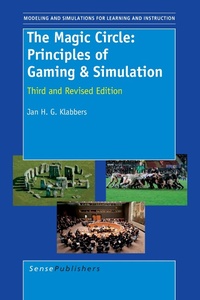
The Magic Circle: Principles of Gaming & Simulation
Third and Revised Edition
3rd Edition
Published on 1. January 2009
Book
Paperback/Softback
400 pages
978-90-8790-006-9 (ISBN)
Description
The purpose of this unique book is to outline the core of game science by presenting principles underlying the design and use of games and simulations. Game science covers three levels of discourse: the philosophy of science level, the science level, and the application or practical level. The framework presented will help to grasp the interplay between forms of knowledge and knowledge content, interplay that evolves through the action of the players.
Few scientists have witnessed such a radical change in their area of research and practice as those who engaged in play and gaming since the 1950s. Since that time game scientists from a whole variety of disciplines started adopting gaming and simulation methods in their research. Rapid advances in information technology and computer science are producing a tool rich environment for the design and use of games, and for humanities studies of games as digital arts and interactive narratives. Game science is advancing through these waves of change, driven by the digital computer game industry, enhanced through computer and information science, as well as through advances in professional gaming such as in education, public and business management, policy development, health care, eco-systems management, and so on.
When asking game scientists about the core of their science, one should expect to hear diverging answers. The common questions about the core of game and play are not new. They refer to: What is the meaning of game and play? What is real and what is virtual reality? How could we build simple and effective games from complex social systems? Are we able to bring forward a general theory of games? Are we able to help players (social actors) to find smart solutions and approaches to complex issues? How do games enhance learning and how do they improve our thinking capacity and action repertoire?
Current answers to these questions are scattered and inadequate. This book offers a frame-of-reference that will enlighten the characteristics of particular games and simulations from a common perspective. The author pays less attention to instrumental reasoning than on theoretical and methodological questions. Answers will provide a suitable context for addressing design science and analytical science approaches to artifact design and assessment, and theory development and testing. Due to the high diversity of approaches that game science has to accommodate the author chooses an interdisciplinary and where appropriate a meta-disciplinary approach.
Few scientists have witnessed such a radical change in their area of research and practice as those who engaged in play and gaming since the 1950s. Since that time game scientists from a whole variety of disciplines started adopting gaming and simulation methods in their research. Rapid advances in information technology and computer science are producing a tool rich environment for the design and use of games, and for humanities studies of games as digital arts and interactive narratives. Game science is advancing through these waves of change, driven by the digital computer game industry, enhanced through computer and information science, as well as through advances in professional gaming such as in education, public and business management, policy development, health care, eco-systems management, and so on.
When asking game scientists about the core of their science, one should expect to hear diverging answers. The common questions about the core of game and play are not new. They refer to: What is the meaning of game and play? What is real and what is virtual reality? How could we build simple and effective games from complex social systems? Are we able to bring forward a general theory of games? Are we able to help players (social actors) to find smart solutions and approaches to complex issues? How do games enhance learning and how do they improve our thinking capacity and action repertoire?
Current answers to these questions are scattered and inadequate. This book offers a frame-of-reference that will enlighten the characteristics of particular games and simulations from a common perspective. The author pays less attention to instrumental reasoning than on theoretical and methodological questions. Answers will provide a suitable context for addressing design science and analytical science approaches to artifact design and assessment, and theory development and testing. Due to the high diversity of approaches that game science has to accommodate the author chooses an interdisciplinary and where appropriate a meta-disciplinary approach.
More details
Series
Edition
3rd edition
Language
English
Place of publication
Rotterdam
Netherlands
Target group
Professional and scholarly
Edition type
New edition
Product notice
Paperback (trade)
Unsewn / adhesive bound
Dimensions
Height: 234 mm
Width: 156 mm
Thickness: 19 mm
Weight
599 gr
ISBN-13
978-90-8790-006-9 (9789087900069)
Copyright in bibliographic data and cover images is held by Nielsen Book Services Limited or by the publishers or by their respective licensors: all rights reserved.
Schweitzer Classification
Other editions
Additional editions
Book
01/2009
3rd Edition
Sense Publishers
€170.00
Article exhausted; check different version