

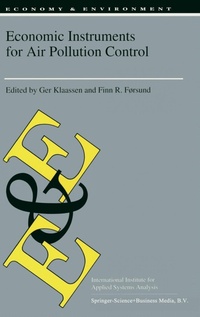
Economic Instruments for Air Pollution Control
1st Edition
Published on 31. October 1994
Book
Hardback
XIX, 283 pages
978-0-7923-3151-3 (ISBN)
Description
Economic theory and empirical models suggest that economic instruments should help us to meet environmental goals at lower cost. Practical experience, however, shows that the cost savings of emission trading are smaller than expected and charges usually have had small incentive impacts.
This book gives the first comprehensive review of economic theory, simulation models, and practical experience with the use of economic instruments. The book focuses on air pollution control. Part I examines theoretical aspects and simulation modeling in a national context. Part II surveys the practical experience in a variety of countries. Part III explores international issues, such as joint implementation.
Because of its unique blend of theoretical and empirical research, the book will prove interesting for both economists and those interested in environmental policy.
More details
Series
Edition
1., 994
Language
English
Place of publication
Dordrecht
United States
Target group
College/higher education
Professional and scholarly
Research
Product notice
sewn/stitched
Cloth over boards
Illustrations
XIX, 283 p.
index
Dimensions
Height: 234 mm
Width: 156 mm
Thickness: 19 mm
Weight
612 gr
ISBN-13
978-0-7923-3151-3 (9780792331513)
DOI
10.1007/978-94-011-1012-9
Schweitzer Classification
Other editions
Additional editions
Ger Klaassen | Finn R. Førsund
Economic Instruments for Air Pollution Control
E-Book
12/2012
Springer
€96.29
Available for download
Ger Klaassen | Finn R. Førsund
Economic Instruments for Air Pollution Control
Book
11/2012
Springer
€106.99
Shipment within 15-20 days
Content
Preface. Introduction. I: National Model Studies. 1. Tradable Discharge Permits: Restrictions on Least-Cost Solutions; S.E. Atkinson. 2. Economic Instruments for the Control of Acid Rain in the UK; A. Pototschnig. 3. Modeling Air Pollution Abatement in a Market-Based Incentive Framework for the Los Angeles Basin; S. Robinson, S. Subramanian, J. Geoghegan. II: National Experiences. 4. Developments in the Use of Economic Instruments in OECD Countries; H. Opschoor. 5. Economic Instruments for Air Pollution Control in Sweden; K. Lövgren. 6. Air Pollution Control in the United States: a Mixed Portfolio Approach; N. Kete. 7. Economic Instruments for Air Pollution Control in Estonia; T. Kallaste. 8. Application of a Pollution Fee System in Russia; A. Golub, E. Strukova. III: International Aspects. 9. Making Carbon Emission Quota Agreements More Efficient: Joint Implementation versus Quota Tradability; P. Bohm. 10. Control of Reciprocal Transboundary Pollution and Joint Implementation; A. Nentjes. 11. Trading Sulfur Emissions in Europe; F.R. Førsund, E. Nævdal. 12. Agency in International Pollution Permit Trading; D. Burtraw. Index.