

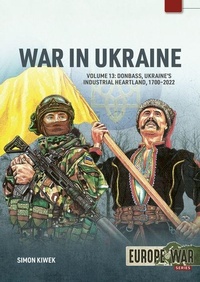
War in Ukraine Volume 13
Donbass, Ukraine's Industrial Heartland, 1700-2022
Will be published approx. on 15. September 2026
Book
Paperback/Softback
88 pages
978-1-80672-287-7 (ISBN)
Description
From Cossack wild fields to ground zero of drone warfare: For centuries, the Donbas has served as Europe's military crucible--through industrial armaments, the Russian Civil War, Soviet supremacy, and the turmoil of the 1990s. Today, this once-forgotten industrial heartland has become the battlefield laboratory where AI, autonomous weapons, and decentralized tactics are redefining modern warfare for the 21st century.
When Belgian industrialists transformed the barren steppe into the Russian Empire's arsenal in the 1860s, they laid the foundation for a region that would repeatedly reshape warfare. British engineer John Hughes built Donetsk that armed tsarist armies. Bolsheviks and White Guards fought their bloodiest battles here, and during the Holodomor, Stalin squeezed the region's grain reserves to finance his war machine.
After communism's collapse, this once-mighty industrial complex fell apart along with the once proud soviet army, becoming a rust belt of outdated 19th-century machinery and economic ruin. Until 2014, when volunteer fighters--often football hooligans with hockey sticks--defended Kyiv's Euromaidan Revolution and marched east to confront Russian-backed separatists.
The Donbas reveals how decentralized innovation replaced state monopolies on warfare. Discover how crowdfunded drone units, battlefield hackers, and AI developers created a "people's military-industrial complex" that NATO generals cannot replicate. From FPV kamikaze drones to autonomous targeting systems, this book exposes the technological arms race transforming combat while traditional armies remain trapped in bureaucratic paralysis.
This is essential reading for military historians, defense analysts, and anyone seeking to understand the economic background of how modern warfare evolved from industrialized battles to AI-powered fields--and why the future of conflict might be decided by startups, not states.
When Belgian industrialists transformed the barren steppe into the Russian Empire's arsenal in the 1860s, they laid the foundation for a region that would repeatedly reshape warfare. British engineer John Hughes built Donetsk that armed tsarist armies. Bolsheviks and White Guards fought their bloodiest battles here, and during the Holodomor, Stalin squeezed the region's grain reserves to finance his war machine.
After communism's collapse, this once-mighty industrial complex fell apart along with the once proud soviet army, becoming a rust belt of outdated 19th-century machinery and economic ruin. Until 2014, when volunteer fighters--often football hooligans with hockey sticks--defended Kyiv's Euromaidan Revolution and marched east to confront Russian-backed separatists.
The Donbas reveals how decentralized innovation replaced state monopolies on warfare. Discover how crowdfunded drone units, battlefield hackers, and AI developers created a "people's military-industrial complex" that NATO generals cannot replicate. From FPV kamikaze drones to autonomous targeting systems, this book exposes the technological arms race transforming combat while traditional armies remain trapped in bureaucratic paralysis.
This is essential reading for military historians, defense analysts, and anyone seeking to understand the economic background of how modern warfare evolved from industrialized battles to AI-powered fields--and why the future of conflict might be decided by startups, not states.
More details
Series
Language
English
Place of publication
Solihull
United Kingdom
Target group
Adult education
Illustrations
5 b/w photos, 64 colour photos, 7 colour maps, 8 figures
Dimensions
Height: 297 mm
Width: 210 mm
ISBN-13
978-1-80672-287-7 (9781806722877)
Copyright in bibliographic data and cover images is held by Nielsen Book Services Limited or by the publishers or by their respective licensors: all rights reserved.
Schweitzer Classification
Person
Simon Kiwek is an economic journalist and analyst specializing in geoeconomics, resource economics, and emerging markets. Since 2021, he is working at Austria's Ministry of Economics, analyzing the world economy with a focus on Russia sanctions and US-China trade conflicts. He studied resource and development economics and launched his own series on economic and geoeconomic trends in developing and emerging markets. His experience in international logistics and extensive travels across Africa, the Middle East, and Eastern Europe--including regular visits to Ukraine since 2016--inform his analysis on regional conflicts.