

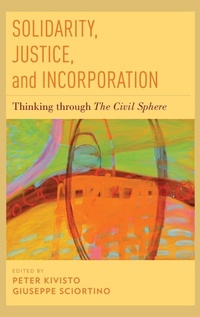
Solidarity, Justice, and Incorporation
Thinking through The Civil Sphere
Published on 21. May 2015
Book
Hardback
216 pages
978-0-19-981190-8 (ISBN)
Description
Although many contemporary scholars have deepened our understanding of civil society, a concept that made its entry into modern social thought in the 17th century, by offering insightful exegetical inquiries into the tradition of thinking about this concept, critiquing the limits of civil society discourse, or seeking to offer empirical analyses of existing civil societies, none have attempted anything as bold or original as Jeffrey C. Alexander's The Civil Sphere.
While consciously building on this three centuries long tradition of thought on the subject, Alexander has broken new ground by articulating in considerable detail a theoretical framework that differs from what he sees as the two major perspectives that have heretofore shaped civil society discourse. In so doing, he has sought to construct from the bottom up a model of what he calls the civil sphere, which he treats in Durkheimian fashion as a new social fact.
In this volume, six internationally recognized scholars comment on the civil sphere thesis. Robert Bellah, Bryan S. Turner, and Axel Honneth consider the work as a whole. Mario Diani, Chad Alan Goldberg, and Farhad Khosrokhavar offer analyses of specific aspects of the civil sphere. In their substantive introduction, Peter Kivisto and Giuseppe Sciortino locate the civil sphere thesis in terms of Alexander's larger theoretical arc as it has shifted from neofunctionalism to cultural sociology. Finally, Alexander's clarifies and further elaborates on the concept of the civil sphere.
While consciously building on this three centuries long tradition of thought on the subject, Alexander has broken new ground by articulating in considerable detail a theoretical framework that differs from what he sees as the two major perspectives that have heretofore shaped civil society discourse. In so doing, he has sought to construct from the bottom up a model of what he calls the civil sphere, which he treats in Durkheimian fashion as a new social fact.
In this volume, six internationally recognized scholars comment on the civil sphere thesis. Robert Bellah, Bryan S. Turner, and Axel Honneth consider the work as a whole. Mario Diani, Chad Alan Goldberg, and Farhad Khosrokhavar offer analyses of specific aspects of the civil sphere. In their substantive introduction, Peter Kivisto and Giuseppe Sciortino locate the civil sphere thesis in terms of Alexander's larger theoretical arc as it has shifted from neofunctionalism to cultural sociology. Finally, Alexander's clarifies and further elaborates on the concept of the civil sphere.
Reviews / Votes
Jeffrey Alexander's The Civil Sphere was an original and powerful book, exploring the cultural dimension of civil society, making explicit the normative grounding of his sociology and offering a distinctively American, non-statist understanding of multiculturalism. This book brings together some international leading theorists to explore as well as challenge Alexander's ideas in ways which illuminate the nature of social solidarity and what sociology can offer our fragmented societies. * Tariq Modood, Director, University of Bristol Research Centre for the Study of Ethnicity and Citizenship * Jeffrey Alexander's The Civil Sphere brought a career of theoretical reflection to bear on some of the biggest challenges of our era. The book's scope and ambition made it challenging, but also offered an invitation to join Alexander in trying to advance both the theory and the reality of civic solidarity. In this new book, six of sociology's leading theorists take up the challenge, Alexander responds, and the debate about civil society and social solidarity is enriched. -Craig C. Calhoun, Director and President, London School of Economics and Political Science This superb new volume of essays reminds us that social solidarities and popular participation are aspirational goals, not settled accomplishments, and have the potential for moral inclusiveness only in a third autonomous sphere of civil society. A consequential set of reflections on an enormously consequential work of original social theory that will serve as a touchstone of critical theory for the foreseeable future. * Margaret R. Somers, Professor of Sociology and History, University of Michigan *More details
Language
English
Place of publication
New York
United States
Target group
College/higher education
Professional and scholarly
Dimensions
Height: 240 mm
Width: 161 mm
Thickness: 18 mm
Weight
536 gr
ISBN-13
978-0-19-981190-8 (9780199811908)
Copyright in bibliographic data and cover images is held by Nielsen Book Services Limited or by the publishers or by their respective licensors: all rights reserved.
Schweitzer Classification
Other editions
Additional editions
Peter Kivisto | Giuseppe Sciortino
Solidarity, Justice, and Incorporation
Thinking through The Civil Sphere
E-Book
04/2015
1st Edition
OUP eBook
€39.49
Available for download
Peter Kivisto | Giuseppe Sciortino
Solidarity, Justice, and Incorporation
Thinking through The Civil Sphere
E-Book
03/2015
1st Edition
OUP eBook
€50.49
Available for download
Persons
Peter Kivisto is the Richard A. Swanson Professor of Social Thought at Augustana College and was formerly the Finland Distinguished Professor at the University of Turku, Finland.
Giuseppe Sciortino is Professor of Sociology at the University of Trento and a Faculty Fellow at Yale University's Center for Cultural Sociology.
Giuseppe Sciortino is Professor of Sociology at the University of Trento and a Faculty Fellow at Yale University's Center for Cultural Sociology.
Content
List of Contributors ; Introduction: Thinking Through the Civil Sphere, Peter Kivisto and Giuseppe Sciortino ; Chapter 1: Religiong and the Civil Sphere: A Global Perspective, Robert Bellah ; Chapter 2: Civil Sphere and Political Performance: Critical Reflections on Jeffrey C. Alexander's Cultural Sociology, Bryan S. Turner ; Chapter 3: Civil Society as a Democratic Battlefield: Comments on Jeffrey C. Alexander's The Civil Sphere, Axel Honneth ; Chapter 4: Social Movements, Civil Repair, and Social Movement Theory, Mario Diani ; Chapter 5: The Jewish Question and the Civil Sphere, Chad Alan Goldberg ; Chapter 6: The Civil Sphere and the Arab Spring: On the Universality of Civil Society, Farhad Khosrokhavar ; Chapter 7: Nine Theses on the Civil Sphere, Jeffrey C. Alexander ; Notes ; Index