

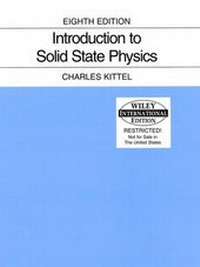
Introduction to Solid State Physics
International Edition
8th Edition
Published on 1. December 2004
Book
Hardback
680 pages
978-0-471-68057-4 (ISBN)
Description
Since the publication of the first edition over 50 years ago, Introduction to Solid State Physics has been the standard solid state physics text for physics majors. The author's goal from the beginning has been to write a book that is accessible to undergraduate and consistently teachable. The emphasis in the book has always been on physics rather than formal mathematics. With each new edition, the author has attempted to add important new developments in the field without sacrificing the book's accessibility and teachability.
More details
Edition
8., Aufl.
Language
English
Place of publication
New York
United States
Publishing group
John Wiley and Sons Ltd
Target group
Adult education
Illustrations
Illustrations
Dimensions
Height: 24.5 cm
Width: 19.7 cm
Thickness: 30 mm
Weight
1192 gr
ISBN-13
978-0-471-68057-4 (9780471680574)
Schweitzer Classification
Other editions
New editions
Charles Kittel
Introduction to Solid State Physics
Book
10/2004
Wiley
€229.00
Article is exhausted; no reprint
Previous edition
Charles Kittel
Introduction to Solid State Physics
Book
07/1995
7th Edition
Wiley
€57.90
Article exhausted; check for reprint
Person
Charles Kittel did his undergraduate work in physics at M.I.T and at the Cavendish Laboratory of Cambridge University. He received his Ph.D. from the University of Wisconsin. He worked in the solid state group at Bell Laboratories, along with Bardeen and Shockley, leaving to start the theoretical solid state physics group at Berkeley in 1951. His research has been largely in magnetism and in semiconductors. In magnetism he developed the theories of ferromagnetic and antiferromagnetic resonance and the theory of single ferromagnetic domains, and extended the Bloch theory of magnons. In semiconductor physics he participated in the first cyclotron and plasma resonance experiments and extended the results to the theory of impurity states and to electron-hole drops.
He has been awarded three Guggenheim fellowships, the Oliver Buckley Prize for Solid State Physics, and, for contributions to teaching, the Oersted Medal of the American Association of Physics Teachers, He is a member of the National Academy of Science and of the American Academy of Arts and Sciences.
Content
1. Crystal Structure. 2. Wave Diffraction and the Reciprocal Lattice. 3. Crystal Binding. 4. Phonons I. Crystal Vibrations. 5. Phonons II. Thermal Properties. 6. Free Electyron Fermi Gas. 7. Energy Bands. 8. Semiconductor Crystals. 9. Fermi Surfaces and Metals. 10. Superconductivity. 11. Diamagnetism and Paramagnetism. 12. Ferromagnetism and Antiferromagnetism. 13. Magnetic Resonance. 14. Plasmons, Polarons, and Polaritons. 15. Optical Processes and Excitons. 16. Dielectrics and Excitons. 17. Surface and Interface Physics. 18. Nanostrutue Solids. 19. Noncrystalline Solids. 20. Point Defects. 21. Disclocations. 22. Alloys.