

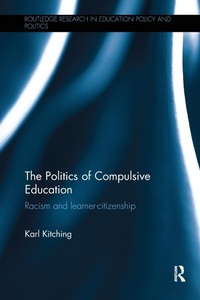
The Politics of Compulsive Education
Racism and learner-citizenship
1st Edition
Published on 30. November 2016
Book
Paperback/Softback
202 pages
978-1-138-28478-4 (ISBN)
Description
The marketised and securitised shaping of formal education sites in terms of risk prevention strategies have transformed what it means to be a learner and a citizen. In this book, Karl Kitching explores racialised dimensions to suggest how individuals and collectives are increasingly made responsible for their own welfare as 'good' or 'bad' students, at the expense of the protection of their rights as learner-citizens. Focusing on Ireland as a post-colonial Atlantic state, the book demonstrates how liberal governance, racisms, migration and mass education are interconnected and struggled over at local, national, European and global levels.
Using a variety of qualitative studies and analytic approaches, The Politics of Compulsive Education details the significance of mass education(s) to the ongoing racialisation of national sovereignty. It draws on in-depth historical, policy, media and school-based research, moving from the 19th century to the present day. Chapters explore diverse themes such as student deportation, austerity and the politics of community 'integration', the depoliticisation of third level education via international student and 'quality' teacher regimes, the racialised distribution of learner 'ability', and school-based bullying and harassment. Combined, these studies demonstrate the possibilities and constraints that exist for educational anti-racisms both in terms of social movements and everyday classroom situations.
The Politics of Compulsive Education asks key questions about anti-racist responsibility across multiple education sites and explores how racisms are both shaped, and can be interrupted, by the interaction of the global and the local, as seen in terms of migration, the distribution of capital, media, education policy discourse, and teacher and learner identifications. It will be of interest to researchers, academics and postgraduate students of sociology, education, cultural studies, political theory, philosophy and postcolonial studies.
Using a variety of qualitative studies and analytic approaches, The Politics of Compulsive Education details the significance of mass education(s) to the ongoing racialisation of national sovereignty. It draws on in-depth historical, policy, media and school-based research, moving from the 19th century to the present day. Chapters explore diverse themes such as student deportation, austerity and the politics of community 'integration', the depoliticisation of third level education via international student and 'quality' teacher regimes, the racialised distribution of learner 'ability', and school-based bullying and harassment. Combined, these studies demonstrate the possibilities and constraints that exist for educational anti-racisms both in terms of social movements and everyday classroom situations.
The Politics of Compulsive Education asks key questions about anti-racist responsibility across multiple education sites and explores how racisms are both shaped, and can be interrupted, by the interaction of the global and the local, as seen in terms of migration, the distribution of capital, media, education policy discourse, and teacher and learner identifications. It will be of interest to researchers, academics and postgraduate students of sociology, education, cultural studies, political theory, philosophy and postcolonial studies.
More details
Series
Language
English
Place of publication
London
United Kingdom
Publishing group
Taylor & Francis Ltd
Target group
College/higher education
Professional and scholarly
Postgraduate and Professional
Dimensions
Height: 234 mm
Width: 156 mm
Thickness: 11 mm
Weight
319 gr
ISBN-13
978-1-138-28478-4 (9781138284784)
Copyright in bibliographic data and cover images is held by Nielsen Book Services Limited or by the publishers or by their respective licensors: all rights reserved.
Schweitzer Classification
Other editions
Additional editions
E-Book
12/2014
1st Edition
Routledge
€65.99
Available for download
E-Book
12/2014
1st Edition
Routledge
€65.99
Available for download
Book
11/2014
1st Edition
Routledge
€243.10
Shipment within 15-20 days
Person
Karl Kitching is a lecturer in the School of Education, University College Cork. He is currently completing an Irish Research Council-funded study titled 'Making Communion: Disappearing and Emerging Forms of Childhood in Ireland' with Dr Yafa Shanneik. Karl is a member of Anti-Deportation Cork, which is a multi-ethnic, grassroots collective that seeks to end the dispersal, detention and deportation of asylum seekers.
Content
1. Compulsive education: The troubling uses of race, migration and learner-citizenship
2. Ambivalent Atlantic encounters: Assembling 'the Irish' as an educable race in the 19th century
3. Purity and diversity as love for the nation: Being heard and contained in educational 'evolution'
4. Mediated blood transfusions and inoculations: desirable/bogus immigrants, and the warmth of Irish educational community
5. 'Where is she from if she's not making her Communion?' Unpacking 'community', integration and segregation in contemporary primary schooling
6. How teachers' bodies are mobilised to feel about diversity: PISA shock, policy motivation and finite inclusion
7. Everyday attributions of ability and value: Blurring designations of good/bad, immigrant/working class Others
8. The 'ebb and flow' of racist micro-aggressions: un/doing everyday uses of and relations between learner bodies
9. Anti-racisms, acts of learner-citizenship and answerability
2. Ambivalent Atlantic encounters: Assembling 'the Irish' as an educable race in the 19th century
3. Purity and diversity as love for the nation: Being heard and contained in educational 'evolution'
4. Mediated blood transfusions and inoculations: desirable/bogus immigrants, and the warmth of Irish educational community
5. 'Where is she from if she's not making her Communion?' Unpacking 'community', integration and segregation in contemporary primary schooling
6. How teachers' bodies are mobilised to feel about diversity: PISA shock, policy motivation and finite inclusion
7. Everyday attributions of ability and value: Blurring designations of good/bad, immigrant/working class Others
8. The 'ebb and flow' of racist micro-aggressions: un/doing everyday uses of and relations between learner bodies
9. Anti-racisms, acts of learner-citizenship and answerability