

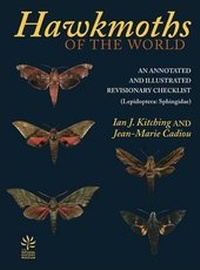
Hawkmoths of the World
An Annotated and Illustrated Revisionary Checklist (Lepidoptera: Sphingidae)
Published on 15. May 2000
Book
Hardback
240 pages
978-0-8014-3734-2 (ISBN)
Description
Hawkmoths are truly spectacular to observe. They are among some of the largest members of the order Lepidoptera. As caterpillars, they have sleek muscular bodies with sidestripes and a tail "horn"; some evoke alarm for their resemblance to poisonous snakes. As adult moths, they use their long tongues to drink nectar from flowers while hovering. Found worldwide, many travel prodigious distances: hummingbird hawkmoths regularly fly to Britain from the Mediterranean.
For this volume, two international authorities on hawkmoths have prepared a comprehensive checklist with species descriptions. Covering more than 3800 family-, genus-, and species-group taxa, it provides a much-needed foundation for research into these insects' systematics and biology.
Hawkmoths of the World opens with an overview of hawkmoth morphology and biology, including discussion of the moths' immature stages, their roles as pollinators and as pests, and their importance in conservation issues. The authors then propose a new system for higher classifications of hawkmoths, one based on the results of the most recent phylogenetic research.
The checklist contains all the nominal taxa of the Sphingidae, as well as the names of aberrations and individual forms. The author of each taxon description is given along with its original date of publication. Two species and two subspecies are described as new. A series of notes clearly explains these and other taxonomic changes, lectotype designations, and related matters. Color plates with 64 photographs further enhance the book.
All those concerned with the conservation of Lepidoptera will welcome the addition of this landmark reference work to their libraries.
For this volume, two international authorities on hawkmoths have prepared a comprehensive checklist with species descriptions. Covering more than 3800 family-, genus-, and species-group taxa, it provides a much-needed foundation for research into these insects' systematics and biology.
Hawkmoths of the World opens with an overview of hawkmoth morphology and biology, including discussion of the moths' immature stages, their roles as pollinators and as pests, and their importance in conservation issues. The authors then propose a new system for higher classifications of hawkmoths, one based on the results of the most recent phylogenetic research.
The checklist contains all the nominal taxa of the Sphingidae, as well as the names of aberrations and individual forms. The author of each taxon description is given along with its original date of publication. Two species and two subspecies are described as new. A series of notes clearly explains these and other taxonomic changes, lectotype designations, and related matters. Color plates with 64 photographs further enhance the book.
All those concerned with the conservation of Lepidoptera will welcome the addition of this landmark reference work to their libraries.
Reviews / Votes
"Kitching and Cadiou propose a new system for higher classification. based on the results of recent phylogenetic research." * Reference and Research Book News *More details
Language
English
Place of publication
Ithaca
United States
Target group
College/higher education
Professional and scholarly
US School Grade: College Graduate Student and over
Illustrations
64 color photographs
Dimensions
Height: 279 mm
Width: 216 mm
Thickness: 27 mm
Weight
57 gr
ISBN-13
978-0-8014-3734-2 (9780801437342)
Copyright in bibliographic data and cover images is held by Nielsen Book Services Limited or by the publishers or by their respective licensors: all rights reserved.
Schweitzer Classification
Persons
Ian James Kitching is Research Entomologist at The Natural History Museum, London. He is co-author of several books, most recently Cladistics: The Theory and Practice of Parsimony Analysis (Second Edition). Jean-Marie Cadiou has spent thirty years acquiring examples of Sphingidae and now has the world's largest collection. He lives in France.