

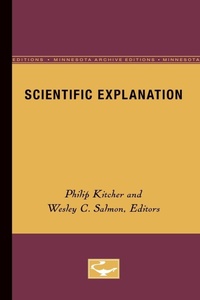
Scientific Explanation
Published on 25. May 1962
Book
Paperback/Softback
544 pages
978-0-8166-5765-0 (ISBN)
Description
Scientific Explanation was first published in 1962. Minnesota Archive Editions uses digital technology to make long-unavailable books once again accessible, and are published unaltered from the original University of Minnesota Press editions.
Is a new consensus emerging in the philosophy of science? The nine distinguished contributors to this volume apply that question to the realm of scientific explanation and, although their conclusions vary, they agree in one respect: there definitely was an old consensus.
Co-editor Wesley Salmon's opening essay, "Four Decades of Scientific Explanation," grounds the entire discussion. His point of departure is the founding document of the old consensus: a 1948 paper by Carl G. Hempel and Paul Oppenheim, "Studies in the Logic of Explanation," that set forth, with remarkable clarity, a mode of argument that came to be known as the deductive-nomological model. This approach, holding that explanation dies not move beyond the sphere of empirical knowledge, remained dominant during the hegemony of logical empiricism from 1950 to 1975. Salmon traces in detail the rise and breakup of the old consensus, and examines the degree to which there is, if not a new consensus, at least a kind of reconciliation on this issue among contemporary philosophers of science and clear agreement that science can indeed tell us why.
The other contributors, in the order of their presentations, are: Peter Railton, Matti Sintonen, Paul W. Humphreys, David Papineau, Nancy Cartwright, James Woodward, Merrilee H. Salmon, and Philip Kitcher.
Is a new consensus emerging in the philosophy of science? The nine distinguished contributors to this volume apply that question to the realm of scientific explanation and, although their conclusions vary, they agree in one respect: there definitely was an old consensus.
Co-editor Wesley Salmon's opening essay, "Four Decades of Scientific Explanation," grounds the entire discussion. His point of departure is the founding document of the old consensus: a 1948 paper by Carl G. Hempel and Paul Oppenheim, "Studies in the Logic of Explanation," that set forth, with remarkable clarity, a mode of argument that came to be known as the deductive-nomological model. This approach, holding that explanation dies not move beyond the sphere of empirical knowledge, remained dominant during the hegemony of logical empiricism from 1950 to 1975. Salmon traces in detail the rise and breakup of the old consensus, and examines the degree to which there is, if not a new consensus, at least a kind of reconciliation on this issue among contemporary philosophers of science and clear agreement that science can indeed tell us why.
The other contributors, in the order of their presentations, are: Peter Railton, Matti Sintonen, Paul W. Humphreys, David Papineau, Nancy Cartwright, James Woodward, Merrilee H. Salmon, and Philip Kitcher.
More details
Series
Language
English
Place of publication
Minnesota
United States
Target group
Professional and scholarly
Dimensions
Height: 229 mm
Width: 152 mm
Thickness: 29 mm
Weight
778 gr
ISBN-13
978-0-8166-5765-0 (9780816657650)
Copyright in bibliographic data and cover images is held by Nielsen Book Services Limited or by the publishers or by their respective licensors: all rights reserved.
Schweitzer Classification
Persons
Wesley C. Salmon was University Professor of Philosophy at the University of Pittsburgh.