

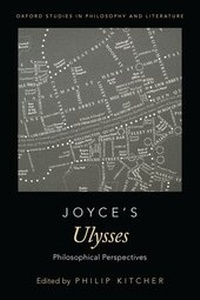
Joyce's Ulysses
Philosophical Perspectives
Published on 30. September 2020
Book
Hardback
280 pages
978-0-19-084226-0 (ISBN)
Description
Though James Joyce was steeped in philosophy and humanism, he has received too little attention from contemporary philosophers in comparison to many of the other titans of modernist fiction. This book probes the possibilities for thinking philosophically about Joyce's masterpiece, Ulysses, presenting readings by renowned scholars such David Hills, Garry L. Hagberg, Vicki Mahaffey, Martha C. Nussbaum, Sam Slote, Wendy J. Truran, and Philip Kitcher, who also provides an introduction to the volume that considers broader themes and situates Ulysses as a work of philosophical interest.
For the central characters of Ulysses--Leopold Bloom, Molly Bloom, and Stephen Dedalus, "How to live?" is an urgent question. Each must either start anew, or attempt to recover lost paths. Chapters plumb the depths of the philosophical quandaries that present themselves to these characters--reflections on death and overcoming disgust, Leopold Bloom's evocations of conscious thought, the dominance of vision in our thinking about the senses, identity, and the possibility of revising one's values are only a handful of the subjects covered in the volume.
Ulysses is an intrinsically and deeply philosophical work, and these readings provide new inroads and firm orientation for Joyce's project. Readers will come away with renewed appreciation for one of our greatest works of literature in the English language, and deepened understanding of Joyce's attempt to offer alternative ways of structuring and enriching the world of our experience.
For the central characters of Ulysses--Leopold Bloom, Molly Bloom, and Stephen Dedalus, "How to live?" is an urgent question. Each must either start anew, or attempt to recover lost paths. Chapters plumb the depths of the philosophical quandaries that present themselves to these characters--reflections on death and overcoming disgust, Leopold Bloom's evocations of conscious thought, the dominance of vision in our thinking about the senses, identity, and the possibility of revising one's values are only a handful of the subjects covered in the volume.
Ulysses is an intrinsically and deeply philosophical work, and these readings provide new inroads and firm orientation for Joyce's project. Readers will come away with renewed appreciation for one of our greatest works of literature in the English language, and deepened understanding of Joyce's attempt to offer alternative ways of structuring and enriching the world of our experience.
Reviews / Votes
This excellent volume does an admirable job of examining Ulysses from a philosophical perspective without, as too often happens, becoming reductionist in its approach to either philosophy or literature...The six essays it contains...work together in a number of complex and extremely suggestive ways...The volume thus creates the feeling of an intelligent conversation between friends (each with their own distinctive point of view) rather than a forced attempt to cover a series of topics.... [T]his volume is to be highly commended for its discovery of a genuinely philosophic approach to Ulysses, one that does not attempt to dig out the hidden 'message' buried in the writing, but that understands that the writing itself is the message...As this volume has admirably shown, Joyce's philosophy is not a lesson he included somewhere in Ulysses, it is Ulysses. * Mind *More details
Series
Language
English
Place of publication
New York
United States
Target group
Professional and scholarly
Dimensions
Height: 146 mm
Width: 225 mm
Thickness: 19 mm
Weight
422 gr
ISBN-13
978-0-19-084226-0 (9780190842260)
Copyright in bibliographic data and cover images is held by Nielsen Book Services Limited or by the publishers or by their respective licensors: all rights reserved.
Schweitzer Classification
Other editions
Additional editions
Book
09/2020
Oxford University Press Inc
€39.50
Shipment within 15-20 days
E-Book
06/2020
1st Edition
OUP eBook
€15.49
Available for download
E-Book
06/2020
1st Edition
OUP eBook
€15.49
Available for download
Person
Philip Kitcher is John Dewey Professor of Philosophy, Emeritus at Columbia. He is the author of numerous books, a Fellow of the American Academy of Arts and Sciences, and the first recipient of the Prometheus Prize, awarded by the American Philosophical Association for work in expanding the frontiers of Science and Philosophy. He has been named a "Friend of Darwin" by the National Committee on Science Education, and received a Lannan Foundation Notable Book Award for Living With Darwin (Oxford University Press, 2007). In 2019, he was awarded the Rescher Medal for contributions to systematic philosophy.
Content
Introduction, Philip Kitcher
Chapter 1. Between Detachment and Disgust: Bloom in Hades, Martha Nussbaum
Chapter 2. A Portrait of Consciousness: Joyce's Ulysses as Philosophical Psychology, Garry Hagberg
Chapter 3. Feeling Ulysses: An Address to the Cyclopean Reader, Vicki Mahaffey and Wendy J. Truran
Chapter 4. Ulysses May Be a Legal Fiction, Sam Slote
Chapter 5. Doing Dublin in Different Voices, David Hills
Chapter 6. Something Rich and Strange: Joyce's Perspectivism, Philip Kitcher
Chapter 1. Between Detachment and Disgust: Bloom in Hades, Martha Nussbaum
Chapter 2. A Portrait of Consciousness: Joyce's Ulysses as Philosophical Psychology, Garry Hagberg
Chapter 3. Feeling Ulysses: An Address to the Cyclopean Reader, Vicki Mahaffey and Wendy J. Truran
Chapter 4. Ulysses May Be a Legal Fiction, Sam Slote
Chapter 5. Doing Dublin in Different Voices, David Hills
Chapter 6. Something Rich and Strange: Joyce's Perspectivism, Philip Kitcher