

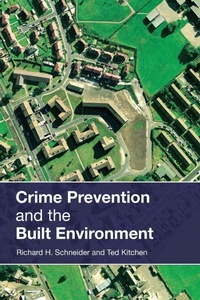
Crime Prevention and the Built Environment
1st Edition
Published on 19. March 2007
Book
Paperback/Softback
276 pages
978-0-415-37325-8 (ISBN)
Description
With a comprehensive analysis, this book links theory, evidence and practical application to bridge gaps between planning, design and criminology. The authors investigate connections between crime prevention and development planning with an international approach, looking at initiatives in the field and incorporating an understanding of current responses to the growth of technology and terrorism.
Reviews / Votes
"A truly international effort ... everyone involved in the development process should have a copy of the book in the library." - Building EngineerMore details
Language
English
Place of publication
London
United Kingdom
Publishing group
Taylor & Francis Ltd
Target group
College/higher education
Professional and scholarly
Illustrations
53 s/w Photographien bzw. Rasterbilder, 27 s/w Zeichnungen, 9 s/w Tabellen
9 Tables, black and white; 27 Line drawings, black and white; 53 Halftones, black and white
Dimensions
Height: 234 mm
Width: 156 mm
Thickness: 16 mm
Weight
456 gr
ISBN-13
978-0-415-37325-8 (9780415373258)
Copyright in bibliographic data and cover images is held by Nielsen Book Services Limited or by the publishers or by their respective licensors: all rights reserved.
Schweitzer Classification
Other editions
Additional editions
Ted Kitchen | Richard H. Schneider
Crime Prevention and the Built Environment
Book
03/2007
1st Edition
Routledge
€262.50
Shipment within 15-20 days
Ted Kitchen | Richard H. Schneider
Crime Prevention and the Built Environment
E-Book
03/2007
Routledge
€86.99
Available for download
Ted Kitchen | Richard H. Schneider
Crime Prevention and the Built Environment
E-Book
03/2007
Routledge
€86.99
Available for download
Persons
Richard H. Schneider is Professor of Urban and Regional Planning at the University of Florida College of Design, Construction and Planning. His research has included work on the design and implementation of technology for crime analysis, the evaluation of crime prevention strategies and the comparison of crime prevention programs at an international level.
Ted Kitchen is Professor Emeritus of Planning and Urban Regeneration at Sheffield Hallam University. Since working as a professional planner, his academic research has centred on planning and urban regeneration practice, focusing in particular on the relationship between planning and crime prevention.
Ted Kitchen is Professor Emeritus of Planning and Urban Regeneration at Sheffield Hallam University. Since working as a professional planner, his academic research has centred on planning and urban regeneration practice, focusing in particular on the relationship between planning and crime prevention.
Content
1. Introduction Part 1: The Theory 2. Classical Theories of Place-Based Crime Prevention 3. Emerging Concepts and Trends Affecting Place-Based Crime Prevention Theory and Practice Part 2: The Practice 4. A Global Perspective on Integrating Crime Prevention into Planning Systems 5. Some UK Police Perspectives on the Process of Planning for Crime Prevention. Crime Prevention and Urban Regeneration-Developing Practice in the UK 7. The Development of Place-Based Anti-Terrorism Strategies in the US 8. The Application of New Technologies to Place-Based Crime Prevention Part 3: Conclusions 9. Conclusions