

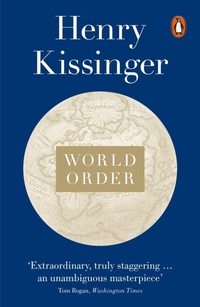
World Order
Reflections on the Character of Nations and the Course of History
Published on 3. September 2015
Book
Paperback/Softback
432 pages
978-0-14-197900-7 (ISBN)
Description
In World Order, Henry Kissinger - one of the leading practitioners of world diplomacy and author of On China - makes his monumental investigation into the 'tectonic plates' of global history and state relations.
World Order is the summation of Henry Kissinger's thinking about history, strategy and statecraft. As if taking a perspective from far above the globe, it examines the great tectonic plates of history and the motivations of nations, explaining the attitudes that states and empires have taken to the rest of the world from the formation of Europe to our own times.
Kissinger identifies four great 'world orders' in history - the European, Islamic, Chinese and American. Since the end of Charlemagne's empire, and especially since the Peace of Westphalia in 1648, Europeans have striven for balance in international affairs, first in their own continent and then globally. Islamic states have looked to their destined expansion over regions populated by unbelievers, a position exemplified today by Iran under the ayatollahs. For over 2000 years the Chinese have seen 'all under Heaven' as being tributary to the Chinese Emperor. America views itself as a 'city on a hill', a beacon to the world, whose values have universal validity.
How have these attitudes evolved and how have they shaped the histories of their nations, regions, and the rest of the world? What has happened when they have come into contact with each other? How have they balanced legitimacy and power at different times? What is the condition of each in our contemporary world, and how are they shaping relations between states now?
To answer these questions Henry Kissinger draws upon a lifetime's historical study and unmatched experience as a world statesman. His account is shot through with observations about how historical change takes place, how some leaders shape their times and others fail to do so, and how far states can stray from the ideas which define them. World Order is a masterpiece of narrative, analysis and portraits of great historical actors that only Henry Kissinger could have written.
World Order is the summation of Henry Kissinger's thinking about history, strategy and statecraft. As if taking a perspective from far above the globe, it examines the great tectonic plates of history and the motivations of nations, explaining the attitudes that states and empires have taken to the rest of the world from the formation of Europe to our own times.
Kissinger identifies four great 'world orders' in history - the European, Islamic, Chinese and American. Since the end of Charlemagne's empire, and especially since the Peace of Westphalia in 1648, Europeans have striven for balance in international affairs, first in their own continent and then globally. Islamic states have looked to their destined expansion over regions populated by unbelievers, a position exemplified today by Iran under the ayatollahs. For over 2000 years the Chinese have seen 'all under Heaven' as being tributary to the Chinese Emperor. America views itself as a 'city on a hill', a beacon to the world, whose values have universal validity.
How have these attitudes evolved and how have they shaped the histories of their nations, regions, and the rest of the world? What has happened when they have come into contact with each other? How have they balanced legitimacy and power at different times? What is the condition of each in our contemporary world, and how are they shaping relations between states now?
To answer these questions Henry Kissinger draws upon a lifetime's historical study and unmatched experience as a world statesman. His account is shot through with observations about how historical change takes place, how some leaders shape their times and others fail to do so, and how far states can stray from the ideas which define them. World Order is a masterpiece of narrative, analysis and portraits of great historical actors that only Henry Kissinger could have written.
Reviews / Votes
Henry Kissinger ... still has remarkable influence. Reading this book, you can see why ... the wit, clarity and concision of his chapters on Europe, America and jihadism are bracing * Economist * Part history, part lecture, part memoir ... Kissinger's conclusion deserves to be read and understood by all candidates ahead of the 2016 presidential election. World order depends on it -- Lionel Barber * Financial Times *More details
Language
English
Place of publication
London
United Kingdom
Target group
College/higher education
Professional and scholarly
Product notice
Paperback (UK-B)
Dimensions
Height: 198 mm
Width: 128 mm
Thickness: 27 mm
Weight
318 gr
ISBN-13
978-0-14-197900-7 (9780141979007)
Copyright in bibliographic data and cover images is held by Nielsen Book Services Limited or by the publishers or by their respective licensors: all rights reserved.
Schweitzer Classification
Other editions
Additional editions
E-Book
09/2014
1st Edition
Penguin Books Ltd
€9.49
Available for download
Person
Henry Kissinger served in the US Army during the Second World War and subsequently held teaching posts in History and Government at Harvard University for twenty years. He served as National Security Advisor and Secretary of State under Richard Nixon and Gerald Ford, and has advised many other American presidents on foreign policy. He received the 1973 Nobel Peace Prize, the Presidential Medal of Freedom, and the Medal of Liberty, among other awards. He is the author of numerous books and articles on foreign policy and diplomacy, including most recently On China and World Order. He is currently Chairman of Kissinger Associates, Inc., an international consulting firm.