


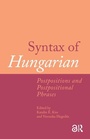
Syntax of Hungarian
Postpositions and Postpositional Phrases
Published on 10. March 2021
Book
Hardback
480 pages
978-94-6372-591-0 (ISBN)
Description
The Syntax of Hungarian aims to present a synthesis of the currently available syntactic knowledge of the Hungarian language, rooted in theory but providing highly detailed descriptions, and intended to be of use to researchers as well as advanced students of language and linguistics. As research in language leads to extensive changes in our understanding and representations of grammar, the Comprehensive Grammar Resources series intends to present the most current understanding of grammar and syntax as completely as possible in a way that will both speak to modern linguists and serve as a resource for the non-specialist.
Reviews / Votes
"The material discussed in Postpositions and postpositional phrases definitely goes beyond what can be found on the often neglected category of adpositions and adverbs elsewhere, in the few traditional descriptive works on the topic (primarily written in Hungarian) and the handful of analytical works in the last 50 years of generative theorising. This book is the first complete overview of this rich grammatical domain, which will no doubt become the standard reference on the topic. It has all qualities of a reference grammar and it reads as a homogeneous and coherent product, clearly the result of substantial team effort and thorough editing."- Janos Egressy and Aniko Liptak, Folia Linguistica, Vol. 56, Iss. 2
More details
Series
Language
English
Place of publication
Amsterdam
Netherlands
Target group
Professional and scholarly
Academic
Product notice
sewn/stitched
Cloth over boards
Dimensions
Height: 240 mm
Width: 160 mm
Thickness: 34 mm
Weight
889 gr
ISBN-13
978-94-6372-591-0 (9789463725910)
Copyright in bibliographic data and cover images is held by Nielsen Book Services Limited or by the publishers or by their respective licensors: all rights reserved.
Schweitzer Classification
Other editions
Additional editions
Book
approx. 12/2025
1st Edition
Routledge
€58.00
Not yet published
E-Book
10/2025
Routledge
€0.00
Available for download
E-Book
10/2025
Routledge
€0.00
Available for download
Persons
Katalin E. Kiss is research professor at the Research Institute for Linguistics in Budapest, Hungary.
Veronika Hegedues is senior research fellow at the Research Institute for Linguistics in Budapest, Hungary.
Veronika Hegedues is senior research fellow at the Research Institute for Linguistics in Budapest, Hungary.
Content
General introduction (Istvan Kenesei, General Editor), 1. The series, 2. Previous research into the grammar of Hungarian, 3. The project, 4. The language, 5. Acknowledgments, References, Chapter 1 General characteristics and overview (Veronika Hegedues), 1.1. Introduction, 1.2. Basic types and properties of postpositions, 1.3. Syntactic uses of postpositions, 1.4. Bibliographical notes, Chapter 2 Postpositions: formal and semantic classification (Eva Dekany and Veronika Hegedues), 2.1. Introduction, 2.2. Formal characterization, 2.3. Semantic classification, 2.4. Where to draw the line: Borderline cases of postpositions, 2.5. Bibliographical notes, Chapter 3 The internal syntax of PPs (Veronika Hegedues and Eva Dekany), 3.1. Introduction, 3.2. Complementation, 3.3. Modification, 3.4. Bibliographical notes, Chapter 4 Predicative PPs (Katalin E. Kiss), 4.1. Introduction, 4.2. PPs used as primary predicates, 4.3. Telicizing PPs, 4.4. Atelic verb modifiers, 4.5. The syntax of verb modifiers, 4.6. Depictives, 4.7. Summary, 4.8. Bibliographical notes, Chapter 5 PPs used as arguments (Gyoergy Rakosi), 5.1. Introduction, 5.2. PPs and verbal particles, 5.3. Core and non-core PP arguments, 5.4. Core and non-core PP arguments of adjectives, 5.5. PP complements in noun phrases, 5.6. Summary, 5.7. Bibliographical notes, Chapter 6 PPs used as obligatory adjuncts (Katalin E. Kiss), 6.1. Introduction, 6.2. Definiteness Effect verbs, 6.3. Types of internal arguments prohibited by the Definiteness Effect, 6.4. Definiteness Effect and aspect, 6.5. Neutralizing the Definiteness Effect by a focused adjunct, 6.6. Summary, 6.7. Bibliographical notes:, Chapter 7 PPs as adjuncts (Barbara Egedi), 7.1. Introduction, 7.2. Categorial types and formal properties of adverbial adjuncts, 7.3. Semantic types of adverbial adjuncts, 7.4. Placement and prosody, 7.5. Summary, 7.6. Bibliographical notes, Subject index, References.