

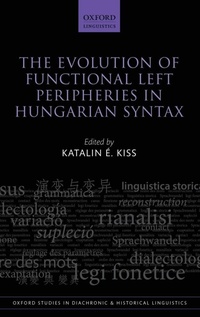
The Evolution of Functional Left Peripheries in Hungarian Syntax
Published on 28. August 2014
Book
Hardback
278 pages
978-0-19-870985-5 (ISBN)
Description
This book adopts a generative framework to investigate the diachronic syntax of Hungarian, one of only a handful of non-Indo-European languages with a documented history spanning more than 800 years. Professor E. Kiss and several internationally recognized experts in the field bring together the best in traditional descriptive linguistics and the state-of-the-art in theoretical linguistics to offer an indepth and original survey of some of the most important structural changes in the history of Hungarian.
The book specifically focuses on the restructuring of Hungarian syntax from head-final to head-initial, which started in the Proto-Hungarian age. This development led to fundamental structural changes, resulting in the evolution of functional left peripheries on various levels of syntactic structure by the 16th century. Chapters examine a number of related topics, including the emergence of focus, topic, and negative quantifiers, the marking of definiteness, universal quantifiers, and non-finite and finite subordination. The mechanisms of change are those observed in Indo-European languages (reanalysis, grammaticalization, cyclicity), but the paths of change have often been different.
The book will be of interest to researchers and graduate students working in historical and diachronic linguistics, as well as all those interested in the mechanisms and theory of linguistic change.
The book specifically focuses on the restructuring of Hungarian syntax from head-final to head-initial, which started in the Proto-Hungarian age. This development led to fundamental structural changes, resulting in the evolution of functional left peripheries on various levels of syntactic structure by the 16th century. Chapters examine a number of related topics, including the emergence of focus, topic, and negative quantifiers, the marking of definiteness, universal quantifiers, and non-finite and finite subordination. The mechanisms of change are those observed in Indo-European languages (reanalysis, grammaticalization, cyclicity), but the paths of change have often been different.
The book will be of interest to researchers and graduate students working in historical and diachronic linguistics, as well as all those interested in the mechanisms and theory of linguistic change.
More details
Series
Language
English
Place of publication
Oxford
United Kingdom
Target group
College/higher education
Dimensions
Height: 240 mm
Width: 161 mm
Thickness: 20 mm
Weight
584 gr
ISBN-13
978-0-19-870985-5 (9780198709855)
Copyright in bibliographic data and cover images is held by Nielsen Book Services Limited or by the publishers or by their respective licensors: all rights reserved.
Schweitzer Classification
Other editions
Additional editions
Katalin É. Kiss
The Evolution of Functional Left Peripheries in Hungarian Syntax
E-Book
08/2014
1st Edition
OUP eBook
€74.99
Available for download
Person
Katalin E. Kiss is Professor at the Research Institute for Linguistics of the Hungarian Academy of Sciences, and at Pazmany Peter Catholic University, where she is also head of the Doctoral School in Linguistics. Her publications include The Syntax of Hungarian (CUP, 2002), Discourse-Configurational Languages (OUP, 1995), Event Structure and the Left Periphery (Springer, 2006), and Adverbs and Adverbial Adjuncts at the Interfaces (De Gruyter, 2009).
Content
1. Introduction ; 2. The evolution of functional left peripheries in the Hungarian sentence ; 3. The DP-cycle in Hungarian and the functional extension of the noun phrase ; 4. From A-quantification to D-quantification: universal quantifiers in the sentence and in the Noun Phrase ; 5. The cyclical development of Ps in Hungarian ; 6. From non-finte to finite subordination: the history of embedded clauses ; Appendix: Corpus building from Old Hungarian codices