

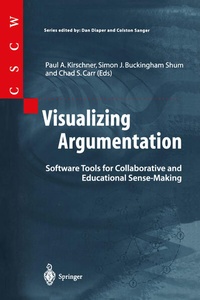
Visualizing Argumentation
Software Tools for Collaborative and Educational Sense-Making
Published on 5. December 2002
Book
Paperback/Softback
XXVI, 216 pages
978-1-85233-664-6 (ISBN)
Description
The field of Computer Supported Argument Visualization is currently
attracting increasing attention in education and business as a means of
helping co-located and virtual groups model and debate controversial
problems. Visualizing Argumentation brings together the leading
practitioners and researchers to provide the first in-depth coverage of
this field. It gives an overview of both the conceptual and technical
foundations, and also provides good coverage of practical issues,
illustrated by real-life case studies. It will be of particular interest
to practitioners and researchers concerned with knowledge management,
software usability, information visualization and knowledge
representation.
Reviews / Votes
From the reviews:
"Clearly written and well organized in this edited book, the purpose of Argument Visualization is to enlighten human intellect by creating collective intellect through dialogues as well as by fostering sense-making learning . . Indeed, this book presents its pioneer role in the CSCW research, and gives visions on the application of CSAV. The experiences from case studies in this book will be highly valuable for any reader who is interested in information technology, computer-in-education, psychology, HCl, knowledge management, computer engineering, or policy makers." (Jin Tan David Yang, Educational Technology and Society, Vol. 6 (3), 2003)
More details
Series
Edition
Softcover reprint of the original 1st ed. 2003
Language
English
Place of publication
London
United Kingdom
Target group
Professional and scholarly
Research
Illustrations
XXVI, 216 p.
Dimensions
Height: 233 mm
Width: 155 mm
Thickness: 14 mm
Weight
379 gr
ISBN-13
978-1-85233-664-6 (9781852336646)
DOI
10.1007/978-1-4471-0037-9
Schweitzer Classification
Content
I Foundations.- 1 The Roots of Computer Supported Argument Visualization.- 2 A Cognitive Framework for Cooperative Problem Solving with Argument Visualization.- II Applications.- 3 Designing Argumentation Tools for Collaborative Learning.- 4 Using Computer Supported Argument Visualization to Teach Legal Argumentation.- 5 Enhancing Deliberation Through Computer Supported Visualization.- 6 Dialog Mapping: Reflections on an Industrial Strength Case Study.- 7 Fostering Collective Intelligence: Helping Groups Use Visualized Argumentation.- 8 Infrastructure for Navigating Interdisciplinary Debates: Critical Decisions for Representing Argumentation.- 9 Visualizing Internetworked Argumentation.- Afterword Douglas C. Engelbart.