

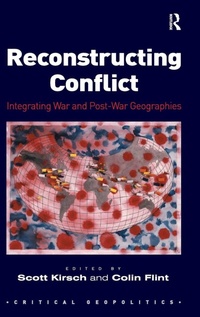
Reconstructing Conflict
Integrating War and Post-War Geographies
Published on 28. May 2011
Book
Hardback
344 pages
978-1-4094-0470-5 (ISBN)
Description
Reconstruction - the rebuilding of state, economy, culture and society in the wake of war - is a powerful idea, and a profoundly transformative one. From the refashioning of new landscapes in bombed-out cities and towns to the reframing of national identities to accommodate changed historical narratives, the term has become synonymous with notions of "post-conflict" society; it draws much of its rhetorical power from the neat demarcation, both spatially and temporally, between war and peace. The reality is far more complex. In this volume, reconstruction is identified as a process of conflict and of militarized power, not something that clearly demarcates a post-war period of peace. Kirsch and Flint bring together an internationally diverse range of studies by leading scholars to examine how periods of war and other forms of political violence have been justified as processes of necessary and valid reconstruction as well as the role of war in catalyzing the construction of new political institutions and destroying old regimes. Challenging the false dichotomy between war and peace, this book explores instead the ways that war and peace are mutually constituted in the creation of historically specific geographies and geographical knowledges.
Reviews / Votes
'Scott Kirsch and Colin Flint, with their smart contributors, reveal the falseness of the all-too-easy dichotomies between war and peace. In doing so, they collectively help us all to be far more realistically nuanced in how we think about - and practice - the "post-war" rebuilding of trust and social fabric along with roads and bureaucracies. I learned a lot from reading Reconstructing Conflict.' Cynthia Enloe, Clark University, USA, author of Nimo's War, Emma's War: Making Feminist Sense of the Iraq War 'Reconstructing Conflict is a powerful examination of the violence that remains in place after the bombs have stopped falling or the guns have been silenced. What makes the book work so well is that the detailed empirical studies always have broader questions in mind while remaining faithful to the particularity of sites.' Stuart Elden, Durham University, UKMore details
Language
English
Place of publication
London
United Kingdom
Publishing group
Taylor & Francis Ltd
Target group
College/higher education
Dimensions
Height: 240 mm
Width: 161 mm
Thickness: 23 mm
Weight
684 gr
ISBN-13
978-1-4094-0470-5 (9781409404705)
Copyright in bibliographic data and cover images is held by Nielsen Book Services Limited or by the publishers or by their respective licensors: all rights reserved.
Schweitzer Classification
Other editions
Additional editions
Book
11/2016
1st Edition
Routledge
€79.20
Shipment within 10-20 days
E-Book
04/2016
Routledge
€72.49
Available for download
E-Book
04/2016
Routledge
€72.49
Available for download
Persons
Scott Kirsch is associate professor of Geography at the University of North Carolina at Chapel Hill. Colin Flint is Professor of Geography and Political Science at Utah State University.
Content
I: Introduction; 1: Introduction: Reconstruction and the Worlds that War Makes; II: Geographies of War and Reconstruction; 2: Intertwined Spaces of Peace and War: The Perpetual Dynamism of Geopolitical Landscapes; 3: Genocide as Reconstruction: The Political Geography of Democratic Kampuchea; 4: Salient versus Silent Disasters in Post-conflict Aceh, Indonesia; 5: Not Peace, Not War: The Myriad Spaces of Sovereignty, Peace and Conflict in Myanmar/Burma 1; 6: Reconstructing the Colonial Present in British Soldiers' Accounts of the Afghanistan Conflict; 7: Militarising Spaces: A Geographical Exploration of Cyprus; 8: Paying the Price for Freedom: From Destruction toward Reconstruction in Northern France, 1940-1960; III: Hegemony and Conflict: Rethinking Peace; 9: Breaking Iraq: Reconstruction as War; 10: Object Lessons: War and American Democracy in the Philippines; 11: Mapping Intelligence: American Geographers and the Office of Strategic Services and GHQ/SCAP (Tokyo); 12: The US Militarization of a 'Host' Civilian Society: The Case of Postwar Okinawa, Japan; 13: War as Emergency? Constructing and Deconstructing the California Agricultural Landscape; 14: The Hidden War: The "Risk" to Female Soldiers in the US Military; 15: Conclusion