

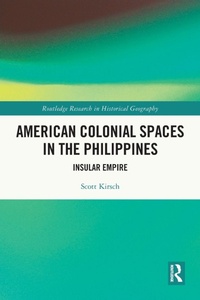
American Colonial Spaces in the Philippines
Insular Empire
1st Edition
Published on 26. August 2024
Book
Paperback/Softback
174 pages
978-1-032-43857-3 (ISBN)
Description
American Colonial Spaces in the Philippines tells the story of U.S. colonialists who attempted, in the first decades of the twentieth century, to build an enduring American empire in the Philippines through the production of space. From concrete interventions in infrastructure, urban planning, and built environments to more abstract projects of mapping and territorialization, the book traces the efforts of U.S. Insular Government agents to make space for empire in the Philippines through forms of territory, map, landscape, and road, and how these spaces were understood as solutions to problems of colonial rule.
Through the lens of space, the book offers an original history of a highly transformative, but largely misunderstood or forgotten, imperial moment, when the Philippine archipelago, made up of thousands of islands and an ethnically and religiously diverse population of more than seven million, became the unlikely primary setting for U.S. experimentation with formal colonial governance. Telling that story around key figures including Cameron Forbes, Daniel Burnham, Dean Worcester, and William Howard Taft, the book provides distinctive chapters dedicated to spaces of territory (sovereignty), maps (knowledge), landscape (aesthetics), and roads (circulation), suggesting new and integrative historical geographical approaches.
This book will be of interest to students of Cultural, Historical, and Political Geography, American History, American Studies, Philippine Studies, Southeast Asia/Philippines; Asian Studies as well as general readers interested in these areas.
The Open Access version of this book, available at http://www.taylorfrancis.com, has been made available under a Creative Commons [Attribution-Non Commercial-No Derivatives (CC BY-NC-ND)] 4.0 license.
Through the lens of space, the book offers an original history of a highly transformative, but largely misunderstood or forgotten, imperial moment, when the Philippine archipelago, made up of thousands of islands and an ethnically and religiously diverse population of more than seven million, became the unlikely primary setting for U.S. experimentation with formal colonial governance. Telling that story around key figures including Cameron Forbes, Daniel Burnham, Dean Worcester, and William Howard Taft, the book provides distinctive chapters dedicated to spaces of territory (sovereignty), maps (knowledge), landscape (aesthetics), and roads (circulation), suggesting new and integrative historical geographical approaches.
This book will be of interest to students of Cultural, Historical, and Political Geography, American History, American Studies, Philippine Studies, Southeast Asia/Philippines; Asian Studies as well as general readers interested in these areas.
The Open Access version of this book, available at http://www.taylorfrancis.com, has been made available under a Creative Commons [Attribution-Non Commercial-No Derivatives (CC BY-NC-ND)] 4.0 license.
Reviews / Votes
The book provides a "spatial vocabulary" that should, in the last instance, help us critique U.S. imperial relations in the past and present to undo them in the near future. It is precisely to the production of American colonial spaces that Scott Kirsch's book directs our attention. In particular, the author explores the production of spaces of sovereignty, knowledge, aesthetics, and circulation, categories that effectively function as organizational principles for the book. American Colonial Spaces in the Philippines is a fantastic book about the contradictory spatial strategies adopted by U.S. empire in the early twentieth century. Historical geographers and historians of empire will find the material discussed here extremely rich and provocative.-Joaquin Villanueva, Department of Environment, Geography, and Earth Sciences, Gustavus Adolphus College, St. Peter, MN. The AAG Review of Books https://doi.org/10.1080/2325548X.2023.2277951
More details
Series
Language
English
Place of publication
London
United Kingdom
Publishing group
Taylor & Francis Ltd
Target group
College/higher education
Professional and scholarly
Academic, Postgraduate, and Undergraduate
Illustrations
21 s/w Abbildungen, 11 s/w Photographien bzw. Rasterbilder, 10 s/w Zeichnungen, 1 s/w Tabelle
1 Tables, black and white; 10 Line drawings, black and white; 11 Halftones, black and white; 21 Illustrations, black and white
Dimensions
Height: 234 mm
Width: 156 mm
Thickness: 10 mm
Weight
295 gr
ISBN-13
978-1-032-43857-3 (9781032438573)
Copyright in bibliographic data and cover images is held by Nielsen Book Services Limited or by the publishers or by their respective licensors: all rights reserved.
Schweitzer Classification
Other editions
Additional editions
Book
02/2023
1st Edition
Routledge
€185.80
Shipment within 15-20 days
E-Book
02/2023
1st Edition
Routledge
€0.00
Available for download
E-Book
02/2023
1st Edition
Routledge
€0.00
Available for download
Person
Scott Kirsch is Professor of Geography at the University of North Carolina at Chapel Hill. He is author of Proving Grounds: Project Plowshare and the Unrealized Dream of Nuclear Earthmoving and editor, with Colin Flint, of Reconstructing Conflict: Integrating War and Post-War Geographies (Routledge).
Content
Introduction 1 Insular Territory: War, Democracy, and America's "First Moment of Global Ambition" 2 Map: U.S. Colonial Science, Geo-Politics, and the Remapping of the Philippines 3 Landscape: The Burnham Plans and American Landscape Imperialism in Manila and Baguio 4 Road: W. Cameron Forbes, Philippine Roadwork, and the Production of Space 5 Coda: Insular Empire