

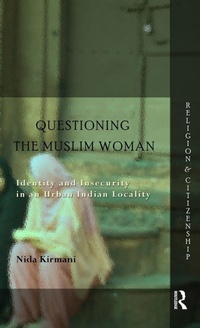
Questioning the 'Muslim Woman'
Identity and Insecurity in an Urban Indian Locality
1st Edition
Published on 25. June 2013
Book
Hardback
246 pages
978-0-415-70780-0 (ISBN)
Description
The marginalisation of Muslims in India has recently been the subject of heated public debate. In these discussions, however, Muslim women are often either overlooked or treated as a homogenous group with a common set of interests. Focusing on the narratives of women living in a predominantly Muslim colony in South Delhi, this book attempts to demonstrate the complexity of their lives and the multiple levels of insecurity they face. Unlike other studies on Indian Muslims that focus on Islam as a defining factor, this book highlights the ways in which religious identity intersects with other identities including class/status, regional affiliation and gender.
The author also sheds light on the impact of such events as the Babri Masjid demolition in 1992 and the subsequent riots, the Gujarat communal carnage in 2002, and the anti-Sikh violence in New Delhi in 1984, along with the rise of Hindutva, and growing Islamophobia experienced worldwide in the post-9/11 period - on the articulation of identities at the local level and increasing religion-based spatial segregation in Indian cities. The study highlights how these incidents combine in different ways to increase the sense of marginalisation experienced by Muslims at the level of the locality.
Understanding the need to look beyond preconceived religious categories, this book will serve as essential reading for those interested in sociology, anthropology, gender, religious and urban studies, as well as policymakers and organisations concerned with issues related to religious minorities in India.
The author also sheds light on the impact of such events as the Babri Masjid demolition in 1992 and the subsequent riots, the Gujarat communal carnage in 2002, and the anti-Sikh violence in New Delhi in 1984, along with the rise of Hindutva, and growing Islamophobia experienced worldwide in the post-9/11 period - on the articulation of identities at the local level and increasing religion-based spatial segregation in Indian cities. The study highlights how these incidents combine in different ways to increase the sense of marginalisation experienced by Muslims at the level of the locality.
Understanding the need to look beyond preconceived religious categories, this book will serve as essential reading for those interested in sociology, anthropology, gender, religious and urban studies, as well as policymakers and organisations concerned with issues related to religious minorities in India.
More details
Series
Language
English
Place of publication
London
United Kingdom
Publishing group
Taylor & Francis Ltd
Target group
College/higher education
Dimensions
Height: 222 mm
Width: 145 mm
Thickness: 17 mm
Weight
446 gr
ISBN-13
978-0-415-70780-0 (9780415707800)
Copyright in bibliographic data and cover images is held by Nielsen Book Services Limited or by the publishers or by their respective licensors: all rights reserved.
Schweitzer Classification
Other editions
Additional editions
E-Book
03/2016
1st Edition
Routledge India
€69.99
Available for download
E-Book
03/2016
1st Edition
American Book Store
€69.99
Available for download
Book
01/2016
1st Edition
Routledge India
€76.10
Shipment within 10-20 days
Person
Nida Kirmani is Assistant Professor of Sociology, Lahore University of Management Sciences, Pakistan.
Content
Preface. Acknowledgements. 1. Locating Identities 2. Constructing the Locality: A Profile of Zakir Nagar 3. Narrating a Muslim Mahol: Identity, Culture and Space 4. History, Memory and Insecurity 5. Boundary Crossings 6. Questioning the 'Muslim Woman' 7. Narrating the Gendered Self 8. Displacing Categories and Replacing Identities. Bibliography. About the Author. Index