

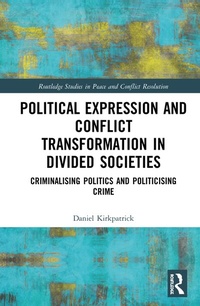
Political Expression and Conflict Transformation in Divided Societies
Criminalising Politics and Politicising Crime
1st Edition
Published on 5. September 2019
Book
Hardback
184 pages
978-0-367-33632-5 (ISBN)
Description
This book considers how the social construction of crime and the criminalising of political expression impact upon different stages in a violent political conflict.
The freedom to express our political opinions is regarded as an essential human right throughout most of the world, and yet, in defence of our security, governments often place various restrictions on it. This book directly considers what these restrictions are in the context of deeply divided societies to understand how they impact upon intergroup relations in four different contexts: nonviolent movements, counter-insurgency, peace negotiations, and post-settlement peacebuilding. Drawing on an extensive body of original interviews and archival material, the volume analyses this relationship through an in-depth consideration of Northern Ireland and South Africa, followed by a wider analysis of Turkey, Sri Lanka, Belgium, and Canada. The overarching argument is that the implications of criminalising political expression depend on both its 'target' and the wider social reality it contributes towards.
This book will be of much interest to students of conflict resolution, transitional justice, law, and International Relations.
The freedom to express our political opinions is regarded as an essential human right throughout most of the world, and yet, in defence of our security, governments often place various restrictions on it. This book directly considers what these restrictions are in the context of deeply divided societies to understand how they impact upon intergroup relations in four different contexts: nonviolent movements, counter-insurgency, peace negotiations, and post-settlement peacebuilding. Drawing on an extensive body of original interviews and archival material, the volume analyses this relationship through an in-depth consideration of Northern Ireland and South Africa, followed by a wider analysis of Turkey, Sri Lanka, Belgium, and Canada. The overarching argument is that the implications of criminalising political expression depend on both its 'target' and the wider social reality it contributes towards.
This book will be of much interest to students of conflict resolution, transitional justice, law, and International Relations.
More details
Series
Language
English
Place of publication
London
United Kingdom
Publishing group
Taylor & Francis Ltd
Target group
College/higher education
Professional and scholarly
Illustrations
6 s/w Abbildungen, 6 s/w Zeichnungen, 14 s/w Tabellen
14 Tables, black and white; 6 Line drawings, black and white; 6 Illustrations, black and white
Dimensions
Height: 234 mm
Width: 156 mm
Weight
426 gr
ISBN-13
978-0-367-33632-5 (9780367336325)
Copyright in bibliographic data and cover images is held by Nielsen Book Services Limited or by the publishers or by their respective licensors: all rights reserved.
Schweitzer Classification
Other editions
Additional editions
Daniel Kirkpatrick
Political Expression and Conflict Transformation in Divided Societies
Criminalising Politics and Politicising Crime
Book
04/2021
1st Edition
Routledge
€68.00
Shipment within 15-20 days
Daniel Kirkpatrick
Political Expression and Conflict Transformation in Divided Societies
Criminalising Politics and Politicising Crime
E-Book
09/2019
1st Edition
Routledge
€61.99
Available for download
Daniel Kirkpatrick
Political Expression and Conflict Transformation in Divided Societies
Criminalising Politics and Politicising Crime
E-Book
09/2019
1st Edition
Routledge
€61.99
Available for download
Person
Daniel Kirkpatrick is a Research Fellow with the Conflict Analysis Research Centre, University of Kent, UK.
Content
Introduction: Mapping the 'crime' of political expression 1. Criminalisation and the social reality of crime Part I: Criminalisation in Context 2. Nonviolent Movements: Criminalising protest and political mobilization 3. Counter-insurgency: Politicising crime to criminalise politics 4. Peace Negotiations: Why negotiate when you can criminalise? 5. Post-settlement: Criminal records and informal decriminalisation Part II: The Evolution of Criminalisation 6. Transforming criminalisation or criminalising transformation in deeply divided societies Conclusion: Criminalising political expression today