

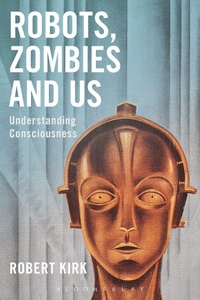
Robots, Zombies and Us
Understanding Consciousness
Published on 23. February 2017
Book
Paperback/Softback
208 pages
978-1-4742-8659-6 (ISBN)
Description
Could robots be genuinely intelligent? Could they be conscious? Could there be zombies? Prompted by these questions Robert Kirk introduces the main problems of consciousness and sets out a new approach to solving them.
He starts by discussing behaviourism, Turing's test of intelligence and Searle's famous Chinese Room argument, and goes on to examine dualism - the idea that consciousness requires something beyond the physical - together with its opposite, physicalism. Probing the idea of zombies, he concludes they are logically impossible. Having presented the central problems, he sketches his solution: a version of functionalism, according to which consciousness consists in the performance of functions.
While there is wide agreement among philosophers about what the main problems of consciousness are, there is little agreement on how to go about solving them. With this powerful case for his version of functionalism, Kirk offers an engaging introduction to both the problems and a possible solution.
He starts by discussing behaviourism, Turing's test of intelligence and Searle's famous Chinese Room argument, and goes on to examine dualism - the idea that consciousness requires something beyond the physical - together with its opposite, physicalism. Probing the idea of zombies, he concludes they are logically impossible. Having presented the central problems, he sketches his solution: a version of functionalism, according to which consciousness consists in the performance of functions.
While there is wide agreement among philosophers about what the main problems of consciousness are, there is little agreement on how to go about solving them. With this powerful case for his version of functionalism, Kirk offers an engaging introduction to both the problems and a possible solution.
Reviews / Votes
Kirk provides an excellent overview of the philosophical study of consciousness that is at once packed with arguments and accessible to those who are just beginning their study of consciousness. -- Richard Brown, Professor of Philosophy, LaGuardia Community College, CUNY, USA The zombie thought experiment has tormented philosophers for decades. In an ambitious book, Kirk presents an ingenious argument intended to remove the zombie threat once and for all. Like everything in philosophy, it's wildly controversial. But if it works, Kirk has found the Holy Grail: a solution to the hard problem of consciousness, and a theory that can integrate consciousness into our scientific picture of the world. -- Philip Anthony Goff, Associate Professor of Philosophy, Central European University, Hungary.More details
Language
English
Place of publication
London
United Kingdom
Publishing group
Bloomsbury Publishing PLC
Target group
College/higher education
Product notice
Paperback (trade)
Dimensions
Height: 216 mm
Width: 139 mm
Thickness: 17 mm
Weight
296 gr
ISBN-13
978-1-4742-8659-6 (9781474286596)
Copyright in bibliographic data and cover images is held by Nielsen Book Services Limited or by the publishers or by their respective licensors: all rights reserved.
Schweitzer Classification
Other editions
Additional editions
E-Book
02/2017
1st Edition
Bloomsbury Academic
€30.99
Available for download
E-Book
02/2017
1st Edition
Bloomsbury Academic
€30.99
Available for download
Person
Robert Kirk is Emeritus Professor in the Philosophy Department at Nottingham University, UK. His books include Raw Feeling (OUP 1994), Mind and Body (Acumen 2003), Zombies and Consciousness (OUP 2005), and The Conceptual Link from Physical to Mental (OUP 2013).
Content
Preface
1. Introduction
2. Behaviour is not enough
3. Computers and other machines
4. Intelligent robots?
5. Must there be something non-physical?
6. Zombies
7. What's wrong with the zombie idea?
8. The basic package
9. What's needed on top of the basic package
10. Functionalisms
11. Functionalism is compulsory
12. Is there an explanatory gap?
13. Brains in vats and buckets
References
Index
1. Introduction
2. Behaviour is not enough
3. Computers and other machines
4. Intelligent robots?
5. Must there be something non-physical?
6. Zombies
7. What's wrong with the zombie idea?
8. The basic package
9. What's needed on top of the basic package
10. Functionalisms
11. Functionalism is compulsory
12. Is there an explanatory gap?
13. Brains in vats and buckets
References
Index