

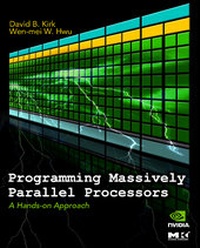
Programming Massively Parallel Processors
A Hands-on Approach
Published on 22. February 2010
Book
Paperback/Softback
280 pages
978-0-12-381472-2 (ISBN)
Description
Programming Massively Parallel Processors discusses the basic concepts of parallel programming and GPU architecture. Various techniques for constructing parallel programs are explored in detail. Case studies demonstrate the development process, which begins with computational thinking and ends with effective and efficient parallel programs.
This book describes computational thinking techniques that will enable students to think about problems in ways that are amenable to high-performance parallel computing. It utilizes CUDA (Compute Unified Device Architecture), NVIDIA's software development tool created specifically for massively parallel environments. Studies learn how to achieve both high-performance and high-reliability using the CUDA programming model as well as OpenCL.
This book is recommended for advanced students, software engineers, programmers, and hardware engineers.
This book describes computational thinking techniques that will enable students to think about problems in ways that are amenable to high-performance parallel computing. It utilizes CUDA (Compute Unified Device Architecture), NVIDIA's software development tool created specifically for massively parallel environments. Studies learn how to achieve both high-performance and high-reliability using the CUDA programming model as well as OpenCL.
This book is recommended for advanced students, software engineers, programmers, and hardware engineers.
Reviews / Votes
"For those interested in the GPU path to parallel enlightenment, this new book from David Kirk and Wen-mei Hwu is a godsend, as it introduces CUDA (tm), a C-like data parallel language, and Tesla(tm), the architecture of the current generation of NVIDIA GPUs. In addition to explaining the language and the architecture, they define the nature of data parallel problems that run well on the heterogeneous CPU-GPU hardware ... This book is a valuable addition to the recently reinvigorated parallel computing literature." --David Patterson, Director of The Parallel Computing Research Laboratory and the Pardee Professor of Computer Science, U.C. Berkeley. Co-author of Computer Architecture: A Quantitative Approach"Written by two teaching pioneers, this book is the definitive practical reference on programming massively parallel processors--a true technological gold mine. The hands-on learning included is cutting-edge, yet very readable. This is a most rewarding read for students, engineers, and scientists interested in supercharging computational resources to solve today's and tomorrow's hardest problems." --Nicolas Pinto, MIT, NVIDIA Fellow, 2009
"I have always admired Wen-mei Hwu's and David Kirk's ability to turn complex problems into easy-to-comprehend concepts. They have done it again in this book. This joint venture of a passionate teacher and a GPU evangelizer tackles the trade-off between the simple explanation of the concepts and the in-depth analysis of the programming techniques. This is a great book to learn both massive parallel programming and CUDA." --Mateo Valero, Director, Barcelona Supercomputing Center
"The use of GPUs is having a big impact in scientific computing. David Kirk and Wen-mei Hwu's new book is an important contribution towards educating our students on the ideas and techniques of programming for massively parallel processors." --Mike Giles, Professor of Scientific Computing, University of Oxford
"This book is the most comprehensive and authoritative introduction to GPU computing yet. David Kirk and Wen-mei Hwu are the pioneers in this increasingly important field, and their insights are invaluable and fascinating. This book will be the standard reference for years to come." --Hanspeter Pfister, Harvard University
"This is a vital and much-needed text. GPU programming is growing by leaps and bounds. This new book will be very welcomed and highly useful across inter-disciplinary fields." --Shannon Steinfadt, Kent State University
"GPUs have hundreds of cores capable of delivering transformative performance increases across a wide range of computational challenges. The rise of these multi-core architectures has raised the need to teach advanced programmers a new and essential skill: how to program massively parallel processors." --CNNMoney.com
"This book is a valuable resource for all students from science and engineering disciplines where parallel programming skills are needed to allow solving compute-intensive problems." --BCS: The British Computer Society's online journal
More details
Language
English
Place of publication
San Francisco
United States
Publishing group
Elsevier Science & Technology
Target group
College/higher education
Advanced Students, Software engineers, Programmers, Hardware Engineers
Illustrations
116 illustrations
Dimensions
Height: 235 mm
Width: 191 mm
Weight
610 gr
ISBN-13
978-0-12-381472-2 (9780123814722)
Copyright in bibliographic data and cover images is held by Nielsen Book Services Limited or by the publishers or by their respective licensors: all rights reserved.
Schweitzer Classification
Other editions
New editions
Book
12/2012
2nd Edition
Morgan Kaufmann
€64.36
Article exhausted; check for reprint
Additional editions
E-Book
02/2010
1st Edition
Morgan Kaufmann
€49.95
Available for download
Persons
David B. Kirk is well recognized for his contributions to graphics hardware and algorithm research. By the time he began his studies at Caltech, he had already earned B.S. and M.S. degrees in mechanical engineering from MIT and worked as an engineer for Raster Technologies and Hewlett-Packard's Apollo Systems Division, and after receiving his doctorate, he joined Crystal Dynamics, a video-game manufacturing company, as chief scientist and head of technology. In 1997, he took the position of Chief Scientist at NVIDIA, a leader in visual computing technologies, and he is currently an NVIDIA Fellow. At NVIDIA, Kirk led graphics-technology development for some of today's most popular consumer-entertainment platforms, playing a key role in providing mass-market graphics capabilities previously available only on workstations costing hundreds of thousands of dollars. For his role in bringing high-performance graphics to personal computers, Kirk received the 2002 Computer Graphics Achievement Award from the Association for Computing Machinery and the Special Interest Group on Graphics and Interactive Technology (ACM SIGGRAPH) and, in 2006, was elected to the National Academy of Engineering, one of the highest professional distinctions for engineers. Kirk holds 50 patents and patent applications relating to graphics design and has published more than 50 articles on graphics technology, won several best-paper awards, and edited the book Graphics Gems III. A technological "evangelist" who cares deeply about education, he has supported new curriculum initiatives at Caltech and has been a frequent university lecturer and conference keynote speaker worldwide. Wen-mei W. Hwu is a Professor and holds the Sanders-AMD Endowed Chair in the Department of Electrical and Computer Engineering, University of Illinois at Urbana-Champaign. His research interests are in the area of architecture, implementation, compilation, and algorithms for parallel computing. He is the chief scientist of Parallel Computing Institute and director of the IMPACT research group (www.impact.crhc.illinois.edu). He is a co-founder and CTO of MulticoreWare. For his contributions in research and teaching, he received the ACM SigArch Maurice Wilkes Award, the ACM Grace Murray Hopper Award, the Tau Beta Pi Daniel C. Drucker Eminent Faculty Award, the ISCA Influential Paper Award, the IEEE Computer Society B. R. Rau Award and the Distinguished Alumni Award in Computer Science of the University of California, Berkeley. He is a fellow of IEEE and ACM. He directs the UIUC CUDA Center of Excellence and serves as one of the principal investigators of the NSF Blue Waters Petascale computer project. Dr. Hwu received his Ph.D. degree in Computer Science from the University of California, Berkeley.
Content
Chapter 1: Introduction
Chapter 2: History of GPU Computing
Chapter 3: Introduction to CUDA
Chapter 4: CUDA Threads
Chapter 5: CUDA Memories
Chapter 6: Performance Considerations
Chapter 7: Floating-Point Considerations
Chapter 8: Application Case Study I - Advanced MRI Reconstruction
Chapter 9: Application Case Study II - Molecular Visualization and Analysis
Chapter 10: Parallel Programming and Computational Thinking
Chapter 11: A Brief Introduction to OpenCL (TM)
Chapter 12: Conclusion and Future Outlook
Appendix A: Matrix Multiplication Example Code
Appendix B: Speed and feed of current generation CUDA devices
Chapter 2: History of GPU Computing
Chapter 3: Introduction to CUDA
Chapter 4: CUDA Threads
Chapter 5: CUDA Memories
Chapter 6: Performance Considerations
Chapter 7: Floating-Point Considerations
Chapter 8: Application Case Study I - Advanced MRI Reconstruction
Chapter 9: Application Case Study II - Molecular Visualization and Analysis
Chapter 10: Parallel Programming and Computational Thinking
Chapter 11: A Brief Introduction to OpenCL (TM)
Chapter 12: Conclusion and Future Outlook
Appendix A: Matrix Multiplication Example Code
Appendix B: Speed and feed of current generation CUDA devices