

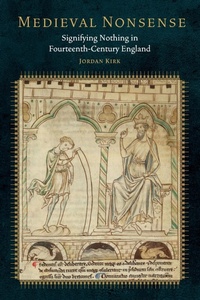
Medieval Nonsense
Signifying Nothing in Fourteenth-Century England
Published on 4. May 2021
Book
Paperback/Softback
208 pages
978-0-8232-9447-3 (ISBN)
Description
Five hundred years before "Jabberwocky" and Tender Buttons, writers were already preoccupied with the question of nonsense. But even as the prevalence in medieval texts of gibberish, babble, birdsong, and allusions to bare voice has come into view in recent years, an impression persists that these phenomena are exceptions that prove the rule of the period's theologically motivated commitment to the kernel of meaning over and against the shell of the mere letter.
This book shows that, to the contrary, the foundational object of study of medieval linguistic thought was vox non-significativa, the utterance insofar as it means nothing whatsoever, and that this fact was not lost on medieval writers of various kinds. In a series of close and unorthodox readings of works by Priscian, Boethius, Augustine, Walter Burley, Geoffrey Chaucer, and the anonymous authors of the Cloud of Unknowing and St. Erkenwald, it inquires into the way that a number of fourteenth-century writers recognized possibilities inherent in the accounts of language transmitted to them from antiquity and transformed those accounts into new ideas, forms, and practices of non-signification. Retrieving a premodern hermeneutics of obscurity in order to provide materials for an archeology of the category of the literary, Medieval Nonsense shows how these medieval linguistic textbooks, mystical treatises, and poems were engineered in such a way as to arrest the faculty of interpretation and force it to focus on the extinguishing of sense that occurs in the encounter with language itself.
This book shows that, to the contrary, the foundational object of study of medieval linguistic thought was vox non-significativa, the utterance insofar as it means nothing whatsoever, and that this fact was not lost on medieval writers of various kinds. In a series of close and unorthodox readings of works by Priscian, Boethius, Augustine, Walter Burley, Geoffrey Chaucer, and the anonymous authors of the Cloud of Unknowing and St. Erkenwald, it inquires into the way that a number of fourteenth-century writers recognized possibilities inherent in the accounts of language transmitted to them from antiquity and transformed those accounts into new ideas, forms, and practices of non-signification. Retrieving a premodern hermeneutics of obscurity in order to provide materials for an archeology of the category of the literary, Medieval Nonsense shows how these medieval linguistic textbooks, mystical treatises, and poems were engineered in such a way as to arrest the faculty of interpretation and force it to focus on the extinguishing of sense that occurs in the encounter with language itself.
More details
Series
Edition
New edition
Language
English
Place of publication
New York
United States
Target group
Professional and scholarly
Edition type
New edition
Product notice
Paperback (trade)
Dimensions
Height: 229 mm
Width: 152 mm
Thickness: 12 mm
Weight
343 gr
ISBN-13
978-0-8232-9447-3 (9780823294473)
Copyright in bibliographic data and cover images is held by Nielsen Book Services Limited or by the publishers or by their respective licensors: all rights reserved.
Schweitzer Classification
Person
Jordan Kirk is Associate Professor of English at Pomona College.
Content
The Wind in the Shell: Prolegomena to the Study of Medieval Nonsignification 1
1 Priscian, Boethius, and Augustine on Vox Sola 27
2 Walter Burley on Suppositio Materialis 52
3 The Cloud of Unknowing on the Litil Worde of O Silable 76
4 St. Erkenwald on the Caracter 98
Acknowledgments 127
Notes 129
Bibliography 157
Index 183
1 Priscian, Boethius, and Augustine on Vox Sola 27
2 Walter Burley on Suppositio Materialis 52
3 The Cloud of Unknowing on the Litil Worde of O Silable 76
4 St. Erkenwald on the Caracter 98
Acknowledgments 127
Notes 129
Bibliography 157
Index 183