

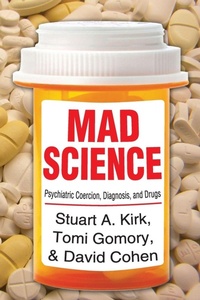
Mad Science
Psychiatric Coercion, Diagnosis, and Drugs
1st Edition
Published on 30. July 2015
Book
Paperback/Softback
358 pages
978-1-4128-5592-1 (ISBN)
Description
*Winner of an honorable mention from theSociety for Social Work and ResearchforOutstanding Social Work Book Award
Mad Science argues that the fundamental claims of modern American psychiatry are based on misconceived, flawed, and distorted science. The authors address multiple paradoxes in American mental health research, including the remaking of coercion into scientific psychiatric treatment, the adoption of an unscientific diagnostic system that controls the distribution of services, and how drug treatments have failed to improve the mental health outcome.
When it comes to understanding and treating mental illness, distortions of research are not rare, misinterpretation of data is not isolated, and bogus claims of success are not voiced by isolated researchers seeking aggrandizement. This book's detailed analysis of coercion and community treatment, diagnosis, and psychopharmacology reveals that these characteristics are endemic, institutional, and protected in psychiatry. They are not just bad science, but mad science.
This book provides an engaging and readable scientific and social critique of current mental health practices. The authors are scholars, researchers, and clinicians who have written extensively about community care, diagnosis, and psychoactive drugs. This paperback edition makes Mad Science accessible to all specialists in the field as well as to the informed public.
Mad Science argues that the fundamental claims of modern American psychiatry are based on misconceived, flawed, and distorted science. The authors address multiple paradoxes in American mental health research, including the remaking of coercion into scientific psychiatric treatment, the adoption of an unscientific diagnostic system that controls the distribution of services, and how drug treatments have failed to improve the mental health outcome.
When it comes to understanding and treating mental illness, distortions of research are not rare, misinterpretation of data is not isolated, and bogus claims of success are not voiced by isolated researchers seeking aggrandizement. This book's detailed analysis of coercion and community treatment, diagnosis, and psychopharmacology reveals that these characteristics are endemic, institutional, and protected in psychiatry. They are not just bad science, but mad science.
This book provides an engaging and readable scientific and social critique of current mental health practices. The authors are scholars, researchers, and clinicians who have written extensively about community care, diagnosis, and psychoactive drugs. This paperback edition makes Mad Science accessible to all specialists in the field as well as to the informed public.
More details
Language
English
Place of publication
New York
United States
Publishing group
Taylor & Francis Inc
Target group
Professional and scholarly
Dimensions
Height: 229 mm
Width: 152 mm
Thickness: 19 mm
Weight
522 gr
ISBN-13
978-1-4128-5592-1 (9781412855921)
Copyright in bibliographic data and cover images is held by Nielsen Book Services Limited or by the publishers or by their respective licensors: all rights reserved.
Schweitzer Classification
Other editions
Additional editions
E-Book
07/2017
Routledge
€65.99
Available for download
E-Book
07/2017
Routledge
€65.99
Available for download
Book
04/2013
1st Edition
Routledge
€207.20
Shipment within 10-15 days
Person
Stuart A. Kirk is distinguished professor emeritus of social welfare at the Luskin School of Public Affairs, University of California, Los Angeles, USA. Tomi Gomory is associate professor of social work at Florida State University, USA and a Fulbright scholar. David Cohen is professor and Marjorie Crump Chair in social welfare at the University of California, Los Angeles, USA. He is also a Fulbright-Tocqueville scholar.
Content
Preface1. Illusions of Psychiatric Progress2. The History and Historians of Madness 3. The Therapeutic Coercion of the Mad in the Community4. And DSM Said: Let There Be Disorder5. The Failure of Descriptive Diagnosis6. Dancing with Drugs7. From Drugs to Medications-and Back8. The Structure of Mad ScienceIndex