

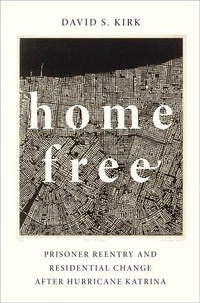
Home Free
Prisoner Reentry and Residential Change after Hurricane Katrina
Published on 18. June 2020
Book
Hardback
248 pages
978-0-19-084123-2 (ISBN)
Description
Each year in the United States, more than 625,000 individuals are released from prison. Half will be back in prison within just three years. Many former prisoners who reoffend return home to their old communities, where the same family, friends, drugs, and criminal opportunities await them.
In Home Free, David S. Kirk uses Hurricane Katrina as a natural experiment to examine whether residential relocation away from an old neighborhood can lead to desistance from crime. Drawing upon both quantitative and qualitative evidence and data from an experimental housing mobility program, he focuses on the lives of individuals released from Louisiana prisons soon after the hurricane, some who moved away from New Orleans and some who did not. Kirk further explores the impact of the Katrina-induced residential change, which provides a unique opportunity to investigate what happens when individuals move not just a short distance away from home, but to entirely different cities, counties, and social worlds. In a series of analyses, Kirk shows the impact that changes in structured daily activities and peer relationships, as well as opportunities for cognitive transformation can have to substantially reduce the likelihood of recidivism.
Addressing one of the biggest challenges now facing the criminal justice system, Home Free offers a story of redemption. In light of the devastation of Hurricane Katrina, Kirk provides important insights into how the power of a fresh start can have considerable policy implications for reducing recidivism.
In Home Free, David S. Kirk uses Hurricane Katrina as a natural experiment to examine whether residential relocation away from an old neighborhood can lead to desistance from crime. Drawing upon both quantitative and qualitative evidence and data from an experimental housing mobility program, he focuses on the lives of individuals released from Louisiana prisons soon after the hurricane, some who moved away from New Orleans and some who did not. Kirk further explores the impact of the Katrina-induced residential change, which provides a unique opportunity to investigate what happens when individuals move not just a short distance away from home, but to entirely different cities, counties, and social worlds. In a series of analyses, Kirk shows the impact that changes in structured daily activities and peer relationships, as well as opportunities for cognitive transformation can have to substantially reduce the likelihood of recidivism.
Addressing one of the biggest challenges now facing the criminal justice system, Home Free offers a story of redemption. In light of the devastation of Hurricane Katrina, Kirk provides important insights into how the power of a fresh start can have considerable policy implications for reducing recidivism.
Reviews / Votes
It is easy to say that this book is a significant contribution to scholarship on the life course of crime, re-entry and desistance, and a must read for policy makers and practitioners working with the formerly incarcerated. The rigorous study design integrating a large quantitative dataset that leverages a natural experiment analytic approach with a deep qualitative inquiry provides a richness of detail about the challenges of re-entry, and how context overlays the process of desisting from crime. * Bianca Bersani, University of Maryland, Rutgers * Kirk offers a mixed-methodology design to investigate the reincarceration rates of ex-prisoners who returned to live in New Orleans after their release after Hurricane Katrina, compared to those who left to live in other places. The quantitative analysis is triangulated with qualitative interviews involving mostly African American ex-inmates to explain why some desisted and others persisted in experiencing reincarceration. * B. Agozino, CHOICE *More details
Language
English
Place of publication
New York
United States
Target group
Professional and scholarly
Product notice
sewn/stitched
Cloth over boards
Dimensions
Height: 239 mm
Width: 155 mm
Thickness: 28 mm
Weight
476 gr
ISBN-13
978-0-19-084123-2 (9780190841232)
Copyright in bibliographic data and cover images is held by Nielsen Book Services Limited or by the publishers or by their respective licensors: all rights reserved.
Schweitzer Classification
Other editions
Person
David S. Kirk is a professor in the Department of Sociology and Professorial Fellow of Nuffield College at Oxford University. At Oxford, he directs the Centre for Social Investigation. His research has appeared in leading outlets such as American Journal of Sociology, American Sociological Review, Criminology, and The Proceedings of the National Academy of Sciences.
Content
Preface
Acknowledgements
Chapter 1. Introduction
Chapter 2. The Wrath of Hurricane Katrina
Chapter 3. Mechanisms of Criminal Persistence
Chapter 4. Residential Relocation as a Remedy to Recidivism
Chapter 5. For Whom Does Moving Matter?
Chapter 6. The Maintenance of Desistance
Chapter 7. People, Places, and Things
Chapter 8. Considering Negative Cases
Chapter 9. Policy Levers to Foster Residential Change and Reduce Recidivism
Epilogue: Residential Relocation Absent a Hurricane
Appendix A. Quantitative Research Design
Appendix B. Qualitative Research Design
References
Acknowledgements
Chapter 1. Introduction
Chapter 2. The Wrath of Hurricane Katrina
Chapter 3. Mechanisms of Criminal Persistence
Chapter 4. Residential Relocation as a Remedy to Recidivism
Chapter 5. For Whom Does Moving Matter?
Chapter 6. The Maintenance of Desistance
Chapter 7. People, Places, and Things
Chapter 8. Considering Negative Cases
Chapter 9. Policy Levers to Foster Residential Change and Reduce Recidivism
Epilogue: Residential Relocation Absent a Hurricane
Appendix A. Quantitative Research Design
Appendix B. Qualitative Research Design
References