

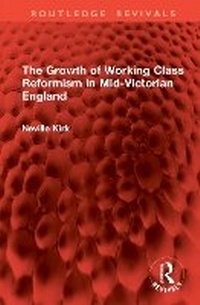
The Growth of Working Class Reformism in Mid-Victorian England
1st Edition
Published on 1. August 2025
Book
Hardback
386 pages
978-1-041-01760-8 (ISBN)
Description
The post-Chartist period saw an easing of class tensions and the growth of a reformist working class. Using evidence based upon the cotton districts of north-west England, the author shows that enhanced socio-political stability owed much to economic restabilisation in his book The Growth of Working Class Reformism in Mid-Victorian England (originally published in 1985).
This book examines new and neglected areas of investigation, including the interplay between class and ethnicity and the institutional and sociological roots of reformism, and brings fresh evidence to bear upon more familiar areas of debate, such as trends in living standards.
A materialist explanation of reformism and stability is propounded. Central importance is attached to the notion of an increasingly fragmented working class operating in a secure economic system which offered enhanced scope for class manoeuvre and labour's advancement. The working class did not become incorporated, collaborationist, or deferential. The frequency of class struggle and continued working class independence could not, however, conceal the fact that the broad features of the system had been accepted. Piecemeal advancement became the order of the day.
This book examines new and neglected areas of investigation, including the interplay between class and ethnicity and the institutional and sociological roots of reformism, and brings fresh evidence to bear upon more familiar areas of debate, such as trends in living standards.
A materialist explanation of reformism and stability is propounded. Central importance is attached to the notion of an increasingly fragmented working class operating in a secure economic system which offered enhanced scope for class manoeuvre and labour's advancement. The working class did not become incorporated, collaborationist, or deferential. The frequency of class struggle and continued working class independence could not, however, conceal the fact that the broad features of the system had been accepted. Piecemeal advancement became the order of the day.
Reviews / Votes
Review of the first publication:'Neville Kirk's well-organized and clearly argued book, focusing upon the cotton district in the 1850-70 period, is a regional study of a particularly significant area.'
- Robert Sykes, Social History, Volume 11, Issue 2
More details
Series
Language
English
Place of publication
London
United Kingdom
Publishing group
Taylor & Francis Ltd
Target group
College/higher education
Postgraduate
Dimensions
Height: 234 mm
Width: 156 mm
Weight
870 gr
ISBN-13
978-1-041-01760-8 (9781041017608)
Copyright in bibliographic data and cover images is held by Nielsen Book Services Limited or by the publishers or by their respective licensors: all rights reserved.
Schweitzer Classification
Other editions
Additional editions
E-Book
08/2025
Routledge
€73.99
Available for download
E-Book
08/2025
Routledge
€73.99
Available for download
Person
Neville Kirk is Emeritus Professor of Social and Labour History at Manchester Metropolitan University, UK. He is an acknowledged expert in the field of labour history.
Content
1. The Growth of Reformism: Debates and Issues 2. The Cotton Districts 3. Economic Growth and Living Standards 4. Labour Leaders and their Institutions 5. Respectability 6. Masters and Operatives 7. Class, Ethnicity and Popular Toryism 8. Conclusion