


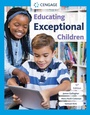
Educating Exceptional Children
14th Edition
Will be published approx. on 5. March 2014
Book
Hardback
560 pages
978-1-285-45134-3 (ISBN)
Description
Authored by luminaries in the special education field, EDUCATING EXCEPTIONAL CHILDREN introduces readers to each of the thirteen disability categories, and discusses the needs of children who are gifted and talented. The fourteenth edition continues to focus on the strengths of previous editions, while also providing new material about such important hot topics as genetics, neurology, inclusion, assistive technology, and information processing. The book provides key, research-based teaching methods and strategies for children with various exceptionalities, and also offers analysis of ecological factors that influence the exceptional child in and out of the classroom. This edition also features a new chapter on children with ADD/ADHD, new diagnosis information from the DSM-5, coverage of CEC and Common Core State Standards, the most current teaching techniques for each category, and current coverage of the Response to Intervention Model.
More details
Edition
14th edition
Language
English
Place of publication
Belmont, CA
United States
Publishing group
Cengage Learning, Inc
Target group
College/higher education
Dimensions
Height: 27 mm
Width: 220 mm
Thickness: 276 mm
Weight
1429 gr
ISBN-13
978-1-285-45134-3 (9781285451343)
Copyright in bibliographic data is held by Nielsen Book Services Limited or its licensors: all rights reserved.
Schweitzer Classification
Other editions
New editions
Samuel Kirk | James Gallagher | Mary Ruth Coleman
Educating Exceptional Children
Book
08/2022
15th Edition
Wadsworth Publishing Co Inc
€93.00
Shipment within 15-20 days
Persons
Samuel Kirk, who wrote the first several editions of EDUCATING EXCEPTIONAL CHILDREN, was a pioneer and "forefather" within the fields of special education and learning disabilities. James J. Gallagher is internationally respected for his research in the areas of giftedness, mental retardation and policy development, among other topics in special education. He was the first director of what was initially called the "Office for the Handicapped" within the Department of Education in Washington DC. Dr. Gallagher is the author of numerous scholarly articles and his work has provided a strong foundation for future advancements in special education. He earned his Ph.D. from Pennsylvania State University. Mary Ruth Coleman joined the author team of EDUCATING EXCEPTIONAL CHILDREN on the 11th Edition. She is the author of numerous scholarly and practitioner-focused articles as well as curriculum and assessment materials. Dr. Coleman served as president of the Council for Exceptional Children in 2007. She earned her Ph.D. in special education and literacy studies from the University of North Carolina at Chapel Hill.
Content
Part I: INTRODUCTION, HISTORY, AND SOCIAL FORCES IN SPECIAL EDUCATION.
1. Children with Exceptionalities and Their Families.
2. Children with Exceptionalities and Social Institutions: Government, Schools, and the Courts.
Part II: HIGH-INCIDENCE EXCEPTIONALITIES.
3. Early Intervention Supports and Services.
4. Children with Intellectual and Developmental Disabilities (IDD).
5. Children with Autism Spectrum Disorders.
6. Children with Learning Disabilities.
7. Children with Attention Deficit Hyperactive Disorders.
8. Children with Emotional and Behavior Disorders.
9. Children with Communication, Language, and Speech Disorders.
10. Children Who Have Special Gifts and Talents.
Part III: LOW-INCIDENCE EXCEPTIONALITIES.
11. Children Who Are Deaf and Hard of Hearing.
12. Children with Visual Impairments.
13. Children with Physical Disabilities, Health Impairments, and Multiple or Severe Disabilities.
1. Children with Exceptionalities and Their Families.
2. Children with Exceptionalities and Social Institutions: Government, Schools, and the Courts.
Part II: HIGH-INCIDENCE EXCEPTIONALITIES.
3. Early Intervention Supports and Services.
4. Children with Intellectual and Developmental Disabilities (IDD).
5. Children with Autism Spectrum Disorders.
6. Children with Learning Disabilities.
7. Children with Attention Deficit Hyperactive Disorders.
8. Children with Emotional and Behavior Disorders.
9. Children with Communication, Language, and Speech Disorders.
10. Children Who Have Special Gifts and Talents.
Part III: LOW-INCIDENCE EXCEPTIONALITIES.
11. Children Who Are Deaf and Hard of Hearing.
12. Children with Visual Impairments.
13. Children with Physical Disabilities, Health Impairments, and Multiple or Severe Disabilities.